Contests for Experimentation††thanks: We thank Martin Cripps, Florian Ederer, Alex Frankel, Qiang Fu, Kobi Glazer, Ed Green, Yingni Guo, Hugo Hopenhayn, Johannes Hörner, Ilan Kremer, Jingfeng Lu, Sofia Moroni, Pauli Murto, Motty Perry, Sven Rady, Ilya Segal, Francesco Squintani, Juuso Välimäki, Julia Wirtz, Tom Wiseman, and various seminar and conference audiences for helpful comments. We appreciate Curtis Taylor’s valuable discussion of the paper. We have also profited from the thoughtful feedback of a Co-Editor and anonymous referees. Andrew Kosenko and Teck Yong Tan provided excellent research assistance. Kartik gratefully acknowledges financial support from the NSF.
Abstract
We study contests for innovation with learning about the innovation’s feasibility and opponents’ outcomes. We characterize contests that maximize innovation when the designer chooses a prize-sharing scheme and a disclosure policy. A “public winner-takes-all contest” dominates public contests—where any success is immediately dis-closed—with any other prize-sharing scheme as well as winner-takes-all contests with any other disclosure policy. Yet, jointly modifying prize sharing and disclosure can increase innovation. In a broad class of mechanisms, it is optimal to share the prize with disclosure following a certain number of successes; under simple conditions, a “hidden equal-sharing” contest is optimal.
1 Introduction
Contests or prize awards are practical and proven mechanisms to procure innovations. Used since at least the 18th century, their popularity has surged in recent decades (McKinsey & Company, 2009). The internet television company Netflix generated significant buzz in 2006 by announcing a $1 million prize to induce a 10% improvement in the accuracy of its movie recommendation algorithm. There is an ongoing $30 million Google Lunar X Prize for landing a private spacecraft on the surface of the Moon and sending “Mooncasts” back to Earth. In the public sector, President Barack Obama signed the America COMPETES Reauthorization Act in 2011 to grant U.S. government agencies the authority to conduct contests to spur innovation. There have also been renewed calls to reform the patent system by using prizes to avoid the deadweight losses of monopoly power (e.g. Stiglitz, 2006).111Debates about the merits of patents versus prizes (versus grants) to encourage innovation date back to at least the 19th century (Machlup and Penrose, 1950, particularly pp. 19–20). In 2011, the U.S. Senator Bernie Sanders proposed two bills that together would create innovation prize funds of 0.57% of U.S. GDP—over $80 billion at the time—for targeted medical research; the bills have not yet been put to vote in Congress. In some domains—e.g., the development of new antibiotics—prizes are advocated not to mitigate the deadweight loss from monopoly power, but rather because the lure of market exclusivity has been insufficient to promote research (Emanuel, 2015).
This paper studies the design of contests for specific innovations. Previous work on contest design has focused on settings in which there is no uncertainty about the environment. By contrast, we emphasize endogenous learning about the desired innovation. We are motivated by applications in which the viability or feasibility of the innovation is uncertain at the outset. Agents update their beliefs over time through their own experimentation—exerting costly effort and observing their outcomes—and also based on what they learn about other agents’ outcomes.
Our model builds on the workhorse exponential-bandit framework (Keller, Rady, and Cripps, 2005). A principal and a set of ex-ante homogenous agents (or contestants) are initially uncertain whether an innovation is feasible or not. If the innovation is feasible, an agent’s instantaneous probability of obtaining the innovation—hereafter, synonymous with “a success”—depends on the agent’s effort. If the innovation is not feasible, success cannot obtain. At each instant of time, each agent chooses how much effort to covertly exert. Whether an agent succeeds or not is only directly observed by that agent and the principal, not by any other agent. All parties are risk neutral.
The principal chooses a prize and, given that prize, a contest design that maximizes innovation, viz., the probability of obtaining one success. Contest design consists of two instruments. First, the principal chooses a prize-sharing scheme, which specifies how the prize will be divided among successful agents as a function of when each agent succeeds. For example, a “winner-takes-all” contest awards the entire prize to the first agent who succeeds, whereas an “equal-sharing” contest gives every agent who succeeds by a deadline an equal share of the prize. Second, the principal chooses a disclosure policy, which specifies what information she discloses over time about agents’ outcomes. For example, a “public” contest reveals to all agents, at every point of time, whether each agent has succeeded or not, whereas a “hidden” contest does not reveal any information until the end of the contest.
In light of the agents’ risk neutrality and the principal valuing only one success, an intuitive solution to the design problem is to use a public winner-takes-all contest. After all, sharing the prize in any other fashion lowers a contestant’s expected reward from success, which should depress effort incentives. Not disclosing success immediately would lead contestants to fear that another contestant may have already succeeded, which should also lower incentives to exert effort. Consistent with this intuition, we show that a public winner-takes-all contest dominates a public contest with any other sharing scheme as well as a winner-takes-all contest with any other disclosure policy.
However, we find that it is possible to increase innovation by jointly modifying both the prize-sharing scheme and the disclosure policy: a hidden equal-sharing contest can dominate a public winner-takes-all contest. The intuition turns on a tradeoff that arises from the uncertainty in the environment. On the one hand, the principal wants to increase each agent’s expected reward from success; this familiar force pushes in favor of using a winner-takes-all contest. On the other hand, the principal also wants to buttress agents’ beliefs about the innovation’s feasibility; this force, which owes entirely to learning, pushes in favor of hiding information—specifically, not disclosing the lack of success by other agents. Crucially, though, the gains from hiding information can only be harnessed by also sharing the prize.
We explain the above intuition using a two-period example in Section 2, before presenting the paper’s main model in Section 3. Our central results on optimal contest design are in Section 4, with our analysis restricted to symmetric equilibria.
Among contests with public and hidden information disclosure, the optimal contest is either public winner-takes-all or hidden equal-sharing. We provide intuitive conditions for when one of these contests dominates the other; for example, hidden equal-sharing is preferred if the value of the innovation is large enough. More broadly, we prove that among contests with rank-monotonic prize schemes—those in which an agent is rewarded no less than another agent who succeeds later—and arbitrary deterministic and symmetric information disclosure policies, it is optimal to use a cutoff-disclosure equal-sharing contest. A cutoff-disclosure policy consists of the principal making an announcement as soon as a critical number of agents have succeeded while remaining silent otherwise. The intuitive conditions that rank public winner-takes-all and hidden equal-sharing contests are also sufficient for optimality of these contests among all contests in the class we study. While we are unable to solve for the optimal contest in full generality, and the principal may be able to do better with contests we do not study, we believe our results contain useful economic lessons and qualify the conventional presumption in favor of winner-takes-all contests.
A notable implication of our results is that the principal may obtain the innovation with higher probability when there are more agents in the contest, despite our model abstracting away from any exogenous forces (e.g., heterogeneity) that favor having multiple agents. Having more agents can be (second-best) optimal because it allows the principal to better harness the benefits from hiding information and sharing the prize.
Section 5 addresses the principal’s optimal choice of the prize and discusses some extensions of the model. Among other things, we show that our main results remain valid under alternative observability structures, such as when only the principal or only an agent observes success directly, and when agents are allowed to communicate their successes to each other. The insight that a hidden equal-sharing contest can dominate a public winner-takes-all contest also applies to a designer who internalizes effort costs, so long as the value of the innovation is larger than the maximum prize available.
The economic forces and insights uncovered in our analysis of contest design are relevant to other contexts in which agents work on projects of uncertain quality or feasibility. Section 6 draws implications for first-to-file versus first-to-invent rules in patent law, optimal task allocation in organizations, and the design of contract awards in government procurement. Although none of these settings fits our setup perfectly, together they illustrate the breadth of applications of our insights on the benefits of limiting disclosure and sharing prizes.
Related literature
A subset of the prior work on contest design concerns research contests rather than innovation contests. The distinction is articulated well by Taylor (1995, p. 874): “in a research tournament, the terminal date is fixed, and the quality of innovations varies, while in an innovation race, the quality standard is fixed, and the date of discovery is variable.” The research-contest literature includes both static (Fullerton and McAfee, 1999; Moldovanu and Sela, 2001; Che and Gale, 2003) and dynamic models (Taylor, 1995). Krishna and Morgan (1998) study a setting where the principal has a fixed budget.
There is a sizable literature on different aspects of innovation or patent races, pioneered by Loury (1979) and Dasgupta and Stiglitz (1980). The focus in this literature is typically only on a winner-takes-all structure and most of it is without learning. Design questions are addressed, for example, by Bhattacharya et al. (1990), Moscarini and Smith (2011) and Judd et al. (2012); see also the references therein.
Our paper is more closely related to work on innovation contests with learning. Choi (1991), Malueg and Tsutsui (1997), Mason and Välimäki (2010), and Moscarini and Squintani (2010) focus on winner-takes-all contests rather than contest design. Choi (1991) considers a multi-stage innovation process and notes that learning about a competitor’s success has a “positive effect” of making an agent more optimistic about the return to his own effort. In our setting, agents do not learn about opponents’ outcomes in a hidden contest; rather, the benefit obtains from an agent’s conjecture about opponents’ success when the prize is shared. In concurrent work, Bimpikis, Ehsani, and Mostagir (2014) compare certain information disclosure policies and reward schemes for the first stage of a two-stage contest. Without characterizing optimal contests, they show that the principal can benefit from hiding information in the first stage.222Their second stage has no learning and has a public winner-takes-all structure. The authors consider three regimes for the first stage: public winner-takes-all, hidden information with no (direct) rewards, and a structure with disclosure only after a given time. Due to discounting and the presence of the second stage, there is social value to having multiple agents succeed in the first stage, whereas we identify (second-best) reasons to use a contest that induces multiple successes even when only the first success is socially valuable. Moroni (2015) studies optimal contracts with multiple agents and stages; see Section 5.1 for a connection with our results.333Contracting with a single agent in the exponential-bandit framework has been studied by Bergemann and Hege (1998, 2005), Gomes et al. (2015), Hörner and Samuelson (2014), and Halac et al. (2016).
More broadly, the exponential-bandit learning framework we follow is now widely used to study multi-agent strategic experimentation (e.g., Keller et al., 2005; Keller and Rady, 2010; Bonatti and Hörner, 2011; Murto and Välimäki, 2011; Cripps and Thomas, 2014), as an alternative to the brownian-motion formulation of Bolton and Harris (1999). Some authors have analyzed how partial information disclosure or strategic communication about experimentation outcomes can improve aggregate learning; see Bimpikis and Drakopoulos (2014), Che and Hörner (2015), Heidhues et al. (2015), and also Kremer et al. (2014) in a non-exponential-bandit framework. All these papers consider a fixed payoff-interdependence structure. Our work stresses the importance of jointly designing both information disclosure and payoff interdependence, the latter determined by the prize-sharing scheme.
Finally, how much information a principal should disclose about agents’ outcomes has been tackled in other contexts. Feedback in multi-stage contests without learning is studied by Aoyagi (2010), Ederer (2010), Goltsman and Mukherjee (2011), and Wirtz (2013). Yildirim (2005), Gill (2008), Rieck (2010), and Akcigit and Liu (2015) address the incentives for contestants to themselves disclose their outcomes to opponents, an issue we take up in Section 5; Campbell et al. (2014) consider related matters in a moral-hazard-in-teams setting. Manso (2011) discusses how much feedback a single agent should be provided about his own experimentation outcomes, and Ely (2015) studies dynamic information disclosure about an exogenous state variable.
2 The Main Idea
This section explains the intuition for our results in a simplified example. A principal wants to obtain a specific innovation. The innovation’s feasibility depends on a binary state—either good or bad—that is persistent and unobservable. The prior probability of the good state is . There are two periods, , no discounting, and two risk-neutral agents. In each period each agent covertly chooses whether to work or shirk. If an agent works in a period and the state is good, the agent succeeds in that period with probability ; if either the agent shirks or the state is bad, the agent does not succeed.444Without loss, an agent who succeeds in the first period cannot—more precisely, will not—exert effort in the second period. Whenever we refer to an agent working in the second period, it is implicitly in the event that he has not succeeded in the first period. Working in a period costs an agent . Successes are conditionally independent across agents given the state and are observed only by the principal and the agent who succeeds. The principal wants to induce both agents to work until at least one succeeds; an additional success provides no extra benefit. The principal has a prize to pay the agents.
In this illustrative setting, we consider four contests. They vary by whether the entire prize is allocated to the first successful agent or divided equally among all agents who succeed by the end of the second period, and by whether an agent’s success in the first period is publicly disclosed or kept hidden.
Public winner-takes-all.
Suppose the principal awards the entire prize to the first agent who obtains a success, and she publicly discloses all successes at the end of each period. If both agents succeed simultaneously, the prize is equally divided (or allocated to either agent with equal probability). In this mechanism, neither agent will work in the second period if either succeeded in the first period. Thus, in any period, if there has been no earlier success and the opponent is exerting effort, an agent’s expected reward for success is . If , it is a dominant strategy for an agent to work in the first period; assume for the rest of this section that this condition holds. If neither agent succeeds in the first period, both agents work in the second period if and only if
| (1) |
where is the agents’ belief in the second period that the state is good given that neither succeeded in the first period having exerted effort.
Public equal-sharing.
Suppose the principal discloses all successes at the end of each period, but she now divides the prize equally between the two agents if both succeed by the end of the second period no matter their order of success (while still allocating the entire prize to an agent if he is the only one to succeed). If an agent succeeds in the first period, the opponent is certain in the second period that the state is good and, due to the shared-prize scheme, the opponent’s reward for success is . Thus, when , an agent does not work in the second period if his opponent succeeds in the first period; in this case, the contest is equivalent to public winner-takes-all (WTA). On the other hand, when , an agent will work in the second period if the opponent succeeds in the first period. This “duplication effort” does not benefit the principal because she values only one success; moreover, as compared to public WTA, agents’ incentives to work in the first period can now be lower due to two reasons: free-riding—an agent may want to wait for the other agent to experiment and reveal information about the state—and a lower expected reward for first-period success due to the opponent’s duplication effort.
In any case, observe that if both agents work in the first period and neither succeeds, the incentive constraint in the second period is still given by (1). Therefore, a public equal-sharing (ES) contest cannot improve on public WTA in the sense that the former cannot induce effort by both agents in both periods when the latter cannot.555An artifact of this two-period, two-agent example is that whenever a public WTA contest induces effort by both agents in both periods, so will a public ES contest. This equivalence is not a general property.
Hidden winner-takes-all.
Suppose the principal awards the entire prize to the first successful agent (and splits the prize in case of simultaneous success) but now she does not disclose any information about first-period successes until the end of the game. Plainly, an agent works in the first period if he is willing to work in the second period. However, because first-period successes are hidden, an agent’s second-period decision must now take into account the possibility that the opponent may have already succeeded and secured the entire prize. When both agents work in the first period, an agent ’s incentive constraint for effort in the second period if he did not succeed in the first is
| (2) |
where denotes ’s opponent. Clearly, constraint (2) is more demanding than (1). In other words, a hidden WTA contest cannot improve on public WTA; moreover, for some parameters, a public WTA contest improves on hidden WTA (see Appendix A.7).
Hidden equal-sharing.
Now suppose the principal combines the equal-sharing prize scheme described earlier with not disclosing any information about first-period successes until the end of the game. Although the prize is shared, there is now no free-riding concern: an agent cannot learn from his opponent’s success when that is not disclosed. In fact, because there is nothing to be learned about the opponent after the first period, it is without loss that an agent works in the first period if he works at all.666“Without loss” in the sense that if there is an equilibrium in which an agent works in the second period (and possibly in the first period too), then there is an outcome-equivalent equilibrium in which this agent works in the first period (and possibly in the second period too).
Suppose there is an equilibrium in which both agents work in the first period and consider an agent’s incentive to work in the second period if he did not succeed in the first. The agent does not know whether the opponent succeeded or failed in the first period. In the event that the opponent succeeded, the agent’s posterior belief that the state is good is one while his reward for success becomes half the prize. On the other hand, in the event the other agent failed in the first period, the agent’s posterior belief is but the expected reward for success is . Hence, an agent ’s incentive constraint in the second period is
| (3) |
It can be checked (see Appendix A.7) that there are parameters under which inequality (3) holds while (1) does not. In other words, there are parameters under which both agents work in both periods in a hidden ES contest but not in a public WTA contest. For these parameters, a hidden ES contest improves on public WTA.
What is the intuition behind why hidden ES can improve on public WTA although neither public ES nor hidden WTA can? On the one hand, holding fixed an agent’s belief about the state, it is clear that a WTA prize scheme maximizes effort incentives. On the other hand, the nature of learning—specifically, failure is bad news—implies that the principal would like to hide information about the opponent’s first-period outcome to bolster an agent’s second-period belief in the only event that matters to the principal, viz. when the opponent fails in the first period. Hiding information but still using WTA is counter-productive, however, because when an agent conditions on obtaining a reward in the second period, he deduces that the opponent must have failed. Consequently, harnessing the benefits of hiding information requires some sharing of the prize. On the flip side, sharing the prize while maintaining public disclosure is not beneficial either because this change from public WTA only alters second-period incentives when the principal does not value additional effort, viz. when the innovation has obtained in the first period.
It bears emphasis that public WTA would be an optimal contest were it certain that the state is good: if there is no learning, there is no benefit to hiding information. Public WTA would also be optimal if agents did learn but only from their own outcomes and not from others’, i.e. if their experimentation “arms” were uncorrelated because their approaches to innovation had no connection. If the principal were to value obtaining a success by each agent, then a public ES contest would sometimes be optimal—sharing the prize has an obvious benefit when success by multiple agents is desired. What is surprising is that ES can be optimal, when paired with hidden information, despite the principal valuing only one success.
These intuitions in hand, we turn to a more general analysis.
3 The Model
3.1 Environment
A principal wants to obtain a specific innovation. Whether the innovation is feasible depends on the state of nature, , where represents “good” and represents “bad”. This state is persistent and unobservable to all parties. There are agents who can work on the principal’s project. Time is continuous and runs from up to some end date , which is chosen by the principal. At every moment , each agent covertly chooses effort at instantaneous cost where . Denote . If and agent exerts effort at time , he succeeds with instantaneous probability at , where is a commonly known parameter. No success can be obtained if . Successes are conditionally independent given the state. We assume that successes are observable only to the agent who succeeds and to the principal; Section 5 discusses alternative scenarios.
When a success is obtained, the principal receives a lump-sum payoff ; the agents do not intrinsically care about success. The principal values only one success: additional successes have no social value. All parties are risk neutral, have quasi-linear preferences, and are expected-utility maximizers. To make our analysis and insights more transparent, we assume no discounting.777As elaborated in Section 5, our finding that an optimal public WTA contest can be dominated by a hidden ES contest is robust to discounting.
Let be the commonly-known prior probability that the state is good. Assume the ex-ante expected marginal benefit of effort is larger than the marginal cost: This means that some experimentation is efficient, even though conditional on the bad state the marginal benefit of effort is zero. Denote by the posterior probability that the state is good when no agent has succeeded by time given a (measurable) effort profile . We refer to as the public belief. By Bayes’ rule,
| (4) |
which is decreasing over time.
Let be the cumulative effort, or experimentation, by agent up to time conditional on him not having succeeded by , and the aggregate cumulative effort up to given no success by . The (aggregate) probability of success is
| (5) |
It follows from (4) that (5) is equivalent to . Hence, as is intuitive:
Remark 1.
For any set of parameters, the probability of success is increasing in aggregate cumulative effort, . Moreover, for any prior belief , a lower public belief at the deadline, , corresponds to a higher probability of success.
3.2 First best
Since it is socially optimal to never exert effort after a success has been obtained, the social optimum is derived by maximizing
To interpret this expression, note that is the probability that no success is obtained by time , and is the probability that the state is good given no success by . Conditional on the good state, a success then occurs at with instantaneous probability , yielding a value . Since the public belief is decreasing over time, a social-welfare maximizing effort profile is for all if and for all otherwise. The first-best stopping (posterior) belief is given by
| (6) |
3.3 Contests and strategies
The principal designs a mechanism to incentivize the agents. As is common, we endow the principal with commitment power and impose limited liability for the agents (i.e., each agent must receive a non-negative payment). In general, a mechanism specifies a deadline and a vector of payments that, without loss, are made at as a function of the principal’s information at (when each agent succeeded, if ever). In addition, a mechanism specifies an information disclosure policy: a distribution over messages for each agent at each time, which may depend on the principal’s information at that time.
We are interested in a sub-class of mechanisms, which we call contests, that restrict both payments and disclosure policies. With regards to payments, a contest specifies a prize amount, simply a prize hereafter, and how that prize is allocated to the agents. Let denote the time at which agent succeeds; by convention, if does not succeed, and we take . The prize-sharing scheme is specified by a tuple of functions , where is the payment to agent when the vector of success times is .888We use bold symbols to denote vectors. Note that an agent is paid the same regardless of whether he succeeds once or more than once. We require the scheme to satisfy three properties: (i) for all , , with for any permutation ; (ii) ; and (iii) .
Requirement (i) says that the prize-sharing scheme must be anonymous.999Relaxing this requirement would only broaden the set of parameters for which an optimal public WTA contest is dominated by a contest that shares the prize and hides information; see fn. 21. An agent’s payment can be interpreted as an expected payment, in which case anonymity implies ex-ante symmetry while permitting ex-post asymmetries via randomization, as elaborated below. Requirement (ii) says that an agent who does not succeed is paid zero; as usual under limited liability, this is without loss of generality. Lastly, requirement (iii) says that the principal must pay out the entire prize if at least one success is obtained.101010This requirement is without loss when a contest designer takes the prize as given and simply maximizes the probability of obtaining the innovation. This is arguably the appropriate objective for contest designers when contests are funded by third parties, as is increasingly frequent (McKinsey & Company, 2009). An interesting parallel is Maskin’s (2002) formulation of the UK government choosing an optimal mechanism to minimize total pollution, subject to the government having a fixed budget to spend on the task. Another interpretation of requirement (iii) is that the prize for success is not monetary. For example, contestants’ incentives often stem from factors such as the publicity received from recognition by the contest (cf. MacCormack et al., 2013, p. 27). Contest design can control how the publicity is allocated among successful contestants. In a different setting but with related motivation, Easley and Ghosh (2013) study a problem of “badge design”. This requirement is a natural property of contests—they are quintessentially about prize allocation—and is consistent with prize awards observed in the real world. Notwithstanding, Section 5.1 describes how our main insights can be extended without this restriction.
As foreshadowed in Section 2, two simple prize-sharing schemes will be of particular interest. A winner-takes-all (WTA) contest is one in which the first agent to succeed receives the entire prize: for all , if and otherwise.111111Notice that the prize scheme is undefined when . As the cumulative probability of simultaneous success is zero, there is no loss in ignoring simultaneous success here and elsewhere. An equal-sharing (ES) contest shares the prize equally among all successful agents: for all , if and otherwise. An ES contest can equivalently be implemented by a lottery that gives each successful agent an equal probability of receiving the entire prize.
Some notation is needed to define information disclosure policies. Let if agent succeeds at time and otherwise, be a profile of outcomes at time , and be the history of outcome profiles up to time . Let be the set of all possible histories of outcome profiles up to time . A disclosure policy is a sequence , where each is a measurable message space for each time , and each is a measurable function capturing the time disclosure rule.121212Each can be endowed with any sigma-algebra that contains each as an element. At each time , all agents observe a common message . Strictly speaking, this setup precludes disclosure policies that treat agents differently depending on their history of success; this is, however, without loss of generality because agents never exert effort after succeeding, so messages sent to successful agents do not matter. Thus, our definition of a disclosure policy rules out disclosure that is stochastic or asymmetric across agents, but is otherwise general.
Two simple disclosure policies will be of particular interest. A public contest is one in which all information about the outcome history is disclosed at all times: for all , and . A hidden contest is one in which no information is disclosed until the end of the contest: for all , . (In either case, the contest runs until its deadline.)
The principal designs a contest to maximize her expected payoff gain, which, given requirement (iii) of the prize-sharing scheme, is the expectation of
| (7) |
where is the aggregate cumulative effort induced by the contest. The principal’s problem can be decomposed into two steps: first, for any given prize , solve for the optimal prize-sharing scheme and information disclosure policy; second, use the first-step solution to solve for the optimal prize. Note that given any , the principal’s objective in the first step is to simply maximize the probability of obtaining a success, i.e. to maximize the expectation of (5).
Let be the private history of agent at time . An agent ’s (pure) strategy is a measurable function that specifies, for each history , a choice of effort at time , . Without loss, we interpret as ’s effort at conditional on him not having succeeded by , as an agent will never exert effort after succeeding. Our solution concept is Nash equilibrium; we restrict attention to symmetric equilibria (viz., equilibria in which all agents use the same strategy).131313Agents will be playing sequentially rationally in the equilibria we characterize of our focal contests, and hence our analysis would not be affected by standard refinements such as (appropriately defined versions of) subgame perfection or perfect Bayesian equilibrium. Regarding symmetry: for some parameters, some contests will have asymmetric equilibria that induce more experimentation than symmetric equilibria. It is common to focus on symmetric equilibria in symmetric contest and experimentation environments (e.g., Moldovanu and Sela, 2001; Bonatti and Hörner, 2011). We say that an agent uses a stopping strategy with stopping time if the agent exerts full effort (i.e., effort of one) until so long as he has not learned that any agent (including himself) has succeeded, followed by no effort after .
4 Optimal Contests
In this section, we take as given an arbitrary prize, , and solve for optimal contests given the prize, i.e. those that maximize the probability of success given . Our main insights concern this step of the principal’s problem; Section 5.1 endogenizes the principal’s choice of prize . Without loss, we take (as the principal will never choose ) and also assume , as otherwise no contest can induce experimentation. We begin our analysis by studying public and hidden contests in Section 4.1 and Section 4.2 respectively, and then compare them in Section 4.3. Section 4.4 tackles contests within a more general class and contains the paper’s main theoretical result.
4.1 Public contests
In a public contest, an agent’s success is immediately disclosed to all other agents. Agents therefore update their beliefs based on their outcomes as well as their opponents’ outcomes, given the equilibrium strategies.
Consider a public contest with an arbitrary prize scheme . Let denote (’s conjecture of) the aggregate effort exerted by ’s opponents at time so long as no agent has obtained a success by . We denote by the expected reward agent receives if he is the first one to succeed at , which depends on and the continuation strategies of the opponents who may continue to exert effort and share the prize. If some agent besides is the first agent to succeed at we denote agent ’s expected continuation payoff by . We suppress the dependence of the relevant variables on the strategy profile to save on notation. Agent ’s problem can then be written as
| (8) |
where is ’s belief that the state is good at time (so long as success has not been obtained), given by the following analog of (4):
To interpret the objective (8), note that is the agent’s belief that no success will obtain by time . Conditional on the good state and no success by , the instantaneous probability that the agent is the first to succeed at is , and the instantaneous probability that an agent besides is the first to succeed at is .
Solving for equilibria in an arbitrary public contest is not straightforward; instead, we take an indirect but also more insightful approach. First, observe that agent can ensure (by exerting no effort after ). It follows that the agent chooses if , and thus requires
| (9) |
where the second inequality is because must be less than the prize . Hence, the lowest belief at which agent is willing to exert effort in a public contest is .
Consider now a public WTA contest, where the full prize is awarded to the first agent who succeeds: and for all . Since the agent’s belief is decreasing over time, the unique solution to (8) in this case is if and otherwise,141414Throughout, we break indifference in favor of exerting effort whenever this is innocuous. where
| (10) |
It follows that in a public WTA contest with deadline , there is a unique equilibrium: all agents exert full effort until either a success is obtained, or the public belief, viz. expression (4) with , reaches (or the deadline binds), and they exert zero effort thereafter. To maximize experimentation, the deadline is optimal if and only if , where is the time at which the public belief reaches given that all agents exert full effort, i.e.,
| (11) |
Comparing with condition (9) above, we see that an optimal public WTA contest induces effort by all agents until their belief reaches the lowest belief at which any agent is willing to exert positive effort in a public contest. It follows that this contest maximizes the probability of success (see Remark 1).
Proposition 1.
A winner-takes-all contest is optimal among public contests. In an optimal public winner-takes-all contest, each agent uses a stopping strategy with stopping time defined by (11). is increasing in and , decreasing in and , and non-monotonic in . The probability of success is increasing in , and , decreasing in , and independent of .
(All proofs are in the Appendix.)
The non-monotonicity of with respect to is due to two countervailing effects: on the one hand, for any given belief , the marginal benefit of effort is larger if is higher; on the other hand, the higher is , the faster each agent updates his belief down following a history of effort and no success (cf. Bobtcheff and Levy, 2014; Halac et al., 2016). Nevertheless, the stopping belief, , is decreasing in , as seen immediately from (10), and as a result the probability of obtaining a success is increasing in . It is also intuitive why is independent of the number of agents: the likelihood that multiple agents succeed at the same instant is second order, hence the only effect of higher on an agent’s incentives at time (so long as no one has succeeded yet) is to lower the public belief at .151515Keller et al. (2005) also have a result that, among “simple” equilibria, the amount of experimentation is invariant to the number of agents. The structure of payoff interdependence in their setting is different from a public WTA contest, however; their key force is free-riding. Owing to the differences, they find that more experimentation can be induced with more agents in “complex” equilibria of their model.
4.2 Hidden contests
In a hidden contest, an agent’s success is not disclosed until the end of the contest. Agents therefore update their beliefs based only on their own outcomes.
Given a hidden contest with prize scheme , denote by the expected reward agent receives if he succeeds at time , which depends on and the strategies of the opponents. Then agent ’s problem reduces to
| (12) |
where is ’s belief that the state is good at time given that he has not succeeded by , which is given by the following analog of (4):
To interpret the objective (12), note that is the agent’s belief that he will not succeed by time . Conditional on the good state and the agent not succeeding by , the agent succeeds at and receives with instantaneous probability .
Consider now a hidden ES contest, where the prize is shared equally among all successful agents. Since ’s expected reward for success, which we denote , is independent of when he succeeds, it is immediate from (12) that an optimal strategy for is a stopping strategy where if and otherwise. Under a stopping strategy,
Let and be the stopping belief and time respectively. Deadline is optimal if and only if , in which case an agent ’s stopping belief satisfies
| (13) |
where
| (14) |
In a symmetric equilibrium, and are independent of and can be denoted and . Should agent succeed at any time, he learns that the state is good, in which event (i) the probability he ascribes to any opponent succeeding (resp., not succeeding) by is (resp., ); and (ii) he views opponents’ successes as independent. Thus, when all opponents use a stopping time , an agent’s expected reward for success in a hidden ES contest is
| (15) |
The summation in (15) is the expected share of the prize that an agent receives for success. It can be shown (see the proof of Proposition 2) that this expected-share expression simplifies to . Substituting this simplification and (14) into (13) implicitly defines the equilibrium stopping time, , by
| (16) |
Each of the two fractions on the left-hand side of (16) is strictly decreasing in ; hence a hidden ES contest has a unique equilibrium among symmetric equilibria in stopping strategies. It can be shown that any symmetric equilibrium must be outcome equivalent to this one in the sense that the probability of success by each agent—equivalently, the private belief reached by the deadline by each agent, and hence the public belief at (see Remark 1)—is the same.161616 For , the unique equilibrium is the symmetric equilibrium in stopping strategies with stopping time . When , even though best responses always exist in stopping strategies, there will be symmetric equilibria in which agents do not play stopping strategies. The reason is that when there are multiple strategies by which an agent can arrive at with a private belief corresponding to the stopping strategy with stopping time defined by (16). However, in any symmetric equilibrium, the cumulative effort by each agent must be ; this is because an agent’s expected share of the prize from success is strictly decreasing in each opponent’s cumulative effort, and his own private belief at is strictly decreasing in his own cumulative effort.
Instead of using equal sharing, the principal may also consider dividing the prize in other ways to increase experimentation; for example, rewarding agents who succeed earlier with larger shares of the prize. However:
Proposition 2.
An equal-sharing contest is optimal among hidden contests. In an optimal hidden equal-sharing contest, there is an equilibrium in which each agent uses a stopping strategy with stopping time defined by (16); furthermore, all symmetric equilibria are outcome equivalent. is increasing in and , decreasing in and , and non-monotonic with respect to . The probability of success is increasing in , and and decreasing in . An increase in can increase or decrease the probability of success.
Let us sketch the argument why it is optimal to share the prize equally among hidden contests. Using the fact that an agent’s expected reward for success is independent of when he succeeds in a hidden ES contest, the proof of Proposition 2 shows that each agent’s (dynamic) incentive constraint binds at each ; that is, at each moment in an optimal hidden ES contest, an agent is indifferent over how much effort to exert given that he has exerted full effort in the past and will behave optimally in the future. Intuitively, exerting no effort at time precludes success at but increases the continuation payoff after (as the private belief does not decrease); these effects cancel when the reward for success is constant over time. That each agent’s incentive constraint is binding at each point is shown to imply that no hidden contest can satisfy all agents’ incentives up to if any agent works beyond ; thus, no hidden contest can induce more cumulative effort from each agent than .
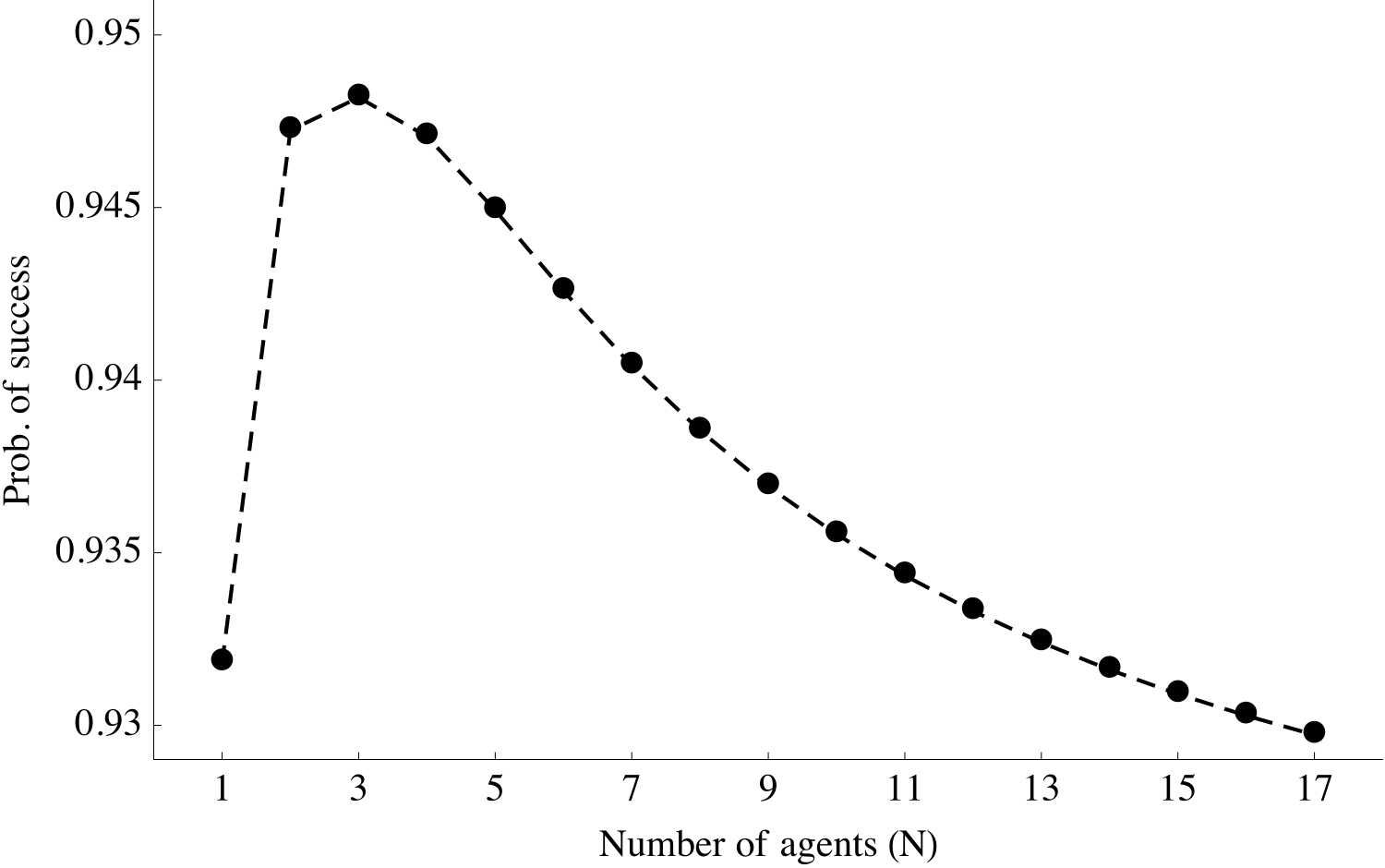
The comparative statics in Proposition 2 are largely intuitive, so we only note two points. First, the non-monotonicity of in owes to the same countervailing forces that were noted after Proposition 1. Second, the probability of obtaining a success may increase or decrease when increases, as shown in Figure 1. Intuitively, holding fixed , conditional on at least one opponent having succeeded (which reveals the state to be good), a larger number of opponents having succeeded only lowers the expected benefit of effort for an agent at . However, an increase in also lowers , which by itself decreases the probability that any opponent has succeeded by conditional on the good state.
4.3 Public versus hidden contests
Proposition 1 shows that a WTA contest is optimal among public contests and Proposition 2 shows that an ES contest is optimal among hidden contests. To compare public contests with hidden contests, it therefore suffices to compare the stopping times identified in those propositions: the principal strictly prefers hidden to public if and only if , where is given by (11) and is given by (16). Since the left-hand side of (11) and that of (16) are each decreasing functions of and respectively, if and only if the left-hand side of (16) would be strictly larger than its right-hand side were .
Proposition 3.
The principal strictly prefers an optimal hidden contest to an optimal public contest if and only if
| (17) |
where is defined by (11).
To see the intuition behind (17), rewrite it as171717Inequality (17) is equivalent to, for any , where denotes an agent’s expected share of the prize for success at in a hidden ES contest given that all opponents use a stopping time and at least one opponent has succeeded. The definition of in (11) implies . Thus, (17) is equivalent to just , which is (18).
| (18) |
Assume all opponents are using a stopping time in a hidden ES contest. At , conditional on all opponents having failed, agent is indifferent over his effort (by definition of ). So, he strictly prefers to continue if and only if he strictly prefers to continue conditional on at least one opponent having succeeded. The left-hand side of (18) is ’s expected benefit from effort at conditional on some opponent having succeeded (which implies the state is good); the right-hand side of (18) is the cost.
When , inequality (18), and hence inequality (17), simplifies to
| (19) |
This condition is transparent: it says that an agent would continue experimenting if he knew his only opponent had already succeeded, in which case he infers the state is good but success will only earn him half the prize.
For , (19) is a necessary condition for the optimal hidden ES contest to dominate the optimal public WTA contest, but it is not sufficient. Inspecting (18), a simple sufficient condition is
| (20) |
This condition says that an agent would continue experimenting if he knew that all his opponents have succeeded. The example in Figure 1 shows that condition (20) is not necessary, as there, hidden ES dominates public WTA for all even though (20) fails when .181818Recall that, as shown in Proposition 1, the probability of success in an optimal public WTA contest is independent of ; hence, it is equal to that under an optimal hidden ES contest when .
An increase in decreases the left-hand side of (17), making the dominance of hidden ES less likely (in the sense of weakly shrinking the set of other parameters for which the inequality holds).191919To verify this claim, use (18): an increase in increases , which decreases the left-hand side of (18) because of a first-order stochastically dominant shift of the relevant probability distribution. This reinforces the intuition that the gains from using hidden ES stem from bolstering agents’ beliefs that the innovation may be feasible despite their own failures, which is more important to the principal when the prior is lower; were , in which case there would be no learning, public WTA would be an optimal contest.202020If condition (20) holds, then hidden ES would also be optimal were . The necessary and sufficient conditions (19) and (20) also reveal that hidden ES dominates (resp., is dominated by) public WTA when is sufficiently small (resp., large).
The discussion above assumes a fixed number of agents. If the principal can instead choose the number of agents, then an optimal hidden ES contest always does at least as well as any public WTA contest. This is because the principal can replicate the public WTA outcome by setting and using hidden ES.212121The principal can effectively reduce the number of agents by using a non-anonymous prize scheme that simply offers no reward for success to some agents. An optimal hidden contest without our restriction to anonymous prize schemes is thus always weakly better than public WTA. Moreover, as seen in Figure 1, a hidden contest with a non-anonymous prize scheme can strictly improve on both hidden ES and public WTA (by effectively reducing to in the figure). Note that the proof of Proposition 1 shows that among public contests, non-anonymous prize schemes cannot improve on WTA. An implication of Proposition 3 is that combining hidden ES with an optimally chosen can be strictly better than using public WTA with any ; this is the case if and only if condition (17) holds. Furthermore, as seen in Figure 1, it can be optimal to set ; this observation contrasts, for example, with a result of Che and Gale (2003) in a different contest environment. The rationale for why multiple agents can be beneficial in our setting appears novel. Our model shuts down standard channels like heterogeneity among agents, convex effort costs, and discounting, so that the number of agents is irrelevant in the first best. Nevertheless, having multiple agents allows the principal to harness the benefits from hiding information and sharing the prize.
4.4 General information disclosure policies
We now turn to disclosure policies beyond the extremes of public and hidden disclosure. A contest is rank monotonic if its prize-sharing scheme is such that if agent succeeds earlier than agent , then receives a weakly larger share of the prize than . Formally, in a rank-monotonic contest, the prize-scheme is such that for any profile of success times , . Recall that our convention is . Proposition 1 and Proposition 2 show that among contests with public and hidden disclosure, the optimal contest is rank monotonic.
For any history of outcomes , denote by the number of successes up to time . A disclosure policy is cutoff disclosure with cutoff if at any time , and if while if . That is, the principal simply makes an announcement () as soon as or more agents have succeeded and is otherwise silent (). Among all possible cutoffs, the following one turns out to be key:
Note that by assumption, and hence is well defined. The value is such that at an ES contest’s deadline, an agent would be willing to exert effort if he knew that some opponent but less than opponents have succeeded; however, if he knew that or more opponents have succeeded, he would not be willing to exert effort.
We can now state the paper’s main result.
Proposition 4.
A cutoff-disclosure equal-sharing contest with cutoff is optimal among rank-monotonic contests.
By definition of , a cutoff-disclosure ES contest with cutoff has the property that all agents stop exerting effort when the principal makes the announcement that agents have succeeded. Moreover, so long as the principal is silent, an agent would be willing to exert effort if he conditions on at least one opponent having succeeded; in fact, the proof of Proposition 4 establishes that an agent always has a best response in stopping strategies, i.e., in which the agent exerts full effort until either the principal makes the announcement or he reaches a stopping time (or he succeeds).
To see the logic behind Proposition 4, consider (symmetric) equilibria in the class of aforementioned best responses. Denote by the agents’ stopping time in an optimal cutoff-disclosure ES contest.222222Similar to our discussion of hidden ES contests, particularly in fn. 16, one can show that all symmetric equilibria are outcome equivalent in an optimal cutoff-disclosure ES contest. If the deadline is chosen to be , the unique equilibrium is the symmetric stopping-strategy equilibrium with stopping time . At , each agent’s cumulative effort (given no success) is equal to and his static incentive constraint for effort binds. If another rank-monotonic contest induced a strictly higher probability of success in some (symmetric) equilibrium, there would be a time in that equilibrium at which each agent’s cumulative effort is also equal to but his static incentive constraint for effort is slack. However, we show that holding fixed any profile of cumulative efforts, the static incentive constraint cannot be relaxed by moving away from cutoff disclosure with cutoff . The reason is that, by rank monotonicity, an agent who succeeds at receives a reward no larger than an equal share of the prize when shared among those who succeeded by , and, by definition of , an agent expects to benefit from exerting effort conditional on the good state and equal sharing if and only if the sharing is with or fewer opponents. As a result, given a history of no success, an agent’s incentive to exert effort is increased if the principal reveals or more successes and is reduced if the principal reveals or less successes.
Observe that when , whereas when . A cutoff-disclosure ES contest with cutoff is equivalent to a public WTA contest, while one with cutoff is equivalent to a hidden ES contest. Thus, we obtain the following generalization of the comparison in Section 4.3:
Corollary 1.
Among rank-monotonic contests, a public winner-takes-all contest is optimal if and a hidden equal-sharing contest is optimal if .
Analogous to Proposition 2, the probability of success in an optimal cutoff-disclosure ES contest need not be monotonic in the number of agents. If the principal can choose the number of agents, she may optimally choose such that (in which case ), but would never choose such that because increasing would be beneficial. A hidden ES contest with agents may induce a higher or lower probability of success than a cutoff-disclosure ES contest with cutoff and agents.
Proposition 4 allows for any (deterministic and symmetric) disclosure policy, but restricts attention to rank-monotonic prize schemes. Within certain classes of information disclosure, rank monotonicity of the prize scheme is not restrictive from the viewpoint of optimality. For example, say that an information disclosure policy is intermittently public if there is a set such that: (i) at any time , the principal sends a message ; and (ii) at any time , the principal sends a message . In other words, the principal reveals the entire history of outcomes at each , while she is silent at each . Intermittently-public contests have a particularly simple disclosure structure and subsume both public and hidden contests. We show in the online appendix (available on the journal’s website) that rank monotonicity is without loss of optimality among intermittently-public contests; it follows that no intermittently-public contest can improve on the optimal cutoff-disclosure ES contest.
Finally, given the salience and widespread use of WTA contests, we record:
Proposition 5.
A public contest is optimal among winner-takes-all contests.
The logic is as discussed earlier: the principal only cares about agents’ effort incentives following a history of no successes; hiding any information about this history in a WTA contest reduces effort incentives because when an agent conditions on some opponent having succeeded, his expected reward for success is zero. Indeed, as is clear from the proposition’s proof, the result also applies to stochastic and asymmetric disclosure.
5 Discussion
Having established our main points, we now study the principal’s problem of choosing the prize and discuss some extensions and variations of our model.
5.1 Optimal prize
Section 4 solved for an optimal contest—one that maximizes the probability of success—given any prize . The second stage of the principal’s problem is to choose an optimal prize. The principal chooses to maximize (7), where is the aggregate cumulative effort induced by an optimal rank-monotonic contest associated with prize . Building on the preceding analysis, the solution to this problem is a cutoff-disclosure ES contest with prize . Furthermore:
Proposition 6.
Fix any set of parameters and consider rank-monotonic contests. When the value of the innovation, , is large (resp., small) enough, the principal maximizes (7) by choosing a prize and a hidden equal-sharing (resp., public winner-takes-all) contest.
The idea is that the larger is , the larger is the principal’s gain from inducing more experimentation, and hence the larger is the optimal prize. For large enough, the principal optimally chooses a prize large enough that ; for small enough, the optimal prize is small enough that . Proposition 6 then follows from Corollary 1.
Our definition of contests in Section 3.3 required the total payment by the principal to be constant so long as there is at least one success (i.e., we have required the principal’s prize scheme to satisfy: ). It is this requirement that implied that given any prize , the principal simply seeks to maximize the probability of success. We could instead assume the principal need not pay out the entire prize after a success (in order to save on payments), but require the total payment to satisfy a budget constraint. That is, given a budget , the principal chooses a contest to maximize the expectation of
subject to a payment scheme satisfying, for all , (and the other requirements described in Section 3.3). For arbitrary parameters of this problem, the optimal payment scheme need not resemble a “contest” in the sense of simply dividing a fixed total prize among successful contestants. Nevertheless, we can show that when in this budget-constrained problem, a hidden ES contest with prize is asymptotically optimal as the value of the innovation becomes large.232323More precisely, for any , a hidden ES contest with prize is -optimal when is large enough. As the total payment the principal makes conditional on at least one success is constant in a hidden ES contest, this implies that restricting attention to payment schemes with this property is almost without loss of optimality when the principal’s budget constraint is tight relative to her value of innovation. Furthermore, any public contest is strictly sub-optimal. Our finding contrasts with Moroni (2015), who shows that a public (i.e., full-disclosure) mechanism is optimal in the absence of a budget constraint. The takeaway is that even when the principal values saving money, hiding information is beneficial when the innovation’s value is (sufficiently) larger than the principal’s budget.
5.2 Observability of success
Our model has assumed that a success is observed by both the agent who succeeds and the principal. We now consider what happens if only the principal or only the agent directly observes a success and can choose whether and when to verifiably reveal it to the other party. We also discuss agents’ ability to verifiably reveal a success to their opponents. In all these cases, we will see that the main results of Section 4 continue to hold.
Only principal observes success.
Suppose the principal observes an agent’s success but the agent does not. The principal can choose when to reveal a success to the agent. This scenario is relevant, for example, to the Netflix contest: there, contestants had to submit an algorithm whose performance was evaluated by Netflix on a proprietary “qualifying dataset” to determine whether the 10% improvement target had been achieved. We suppose that if a success is obtained, the principal must reveal it by the end of the contest; she cannot harness the innovation’s benefits without paying out the prize. We now interpret the arguments of the prize-sharing scheme as the times at which the principal reveals agents’ successes.
It is readily seen that our results extend to this setting. As the principal only values one success and optimally chooses a prize , she has no incentive to not reveal a success immediately to an agent who succeeds. At each time , an agent conditions on not having obtained a success by unless the principal has revealed otherwise. Consequently, the analysis of Section 4 applies without change. Indeed, verifiable revelation by the principal is not essential: the same outcomes can be supported even if the principal is only able to make cheap-talk or unverifiable statements about an agent’s success.
Only agent observes success.
Suppose next that the principal does not observe success directly; rather, any agent who succeeds can choose voluntarily when to verifiably reveal his success to the principal. This assumption is obviously relevant for many applications. The payments are now interpreted as a function of the times at which agents reveal their success.
It is weakly dominant for an agent to immediately reveal his success in a WTA contest. Immediate revelation to the principal is also optimal in a hidden ES contest, and more generally in a cutoff-disclosure ES contest with cutoff . Given the analysis in Section 4, it follows that in any of these contests, there exist symmetric equilibria where agents follow stopping strategies and reveal their successes immediately, inducing the same outcome as when both the principal and the agent directly observe success. Naturally, verifiability is important here; the same outcome cannot be obtained with cheap talk by the agents.
Agents can reveal success to opponents.
Lastly, suppose agents can verifiably reveal their success to other agents. Would they have the incentive to do so? While the issue is moot in public contests, it is paramount in hidden contests, because such an incentive would unravel the principal’s desire to keep successes hidden.
In a hidden ES contest, a successful agent wants to deter opponents from continuing experimenting so that he can secure a larger share of the prize. Revealing a success has two opposing effects: it makes opponents more optimistic about the innovation’s feasibility but decreases their expected prize shares from their own success.242424Once an agent reveals success, all other successful agents will have strict incentives to reveal too: with the uncertainty about the innovation’s feasibility resolved, the only effect of revelation is to lower opponents’ expected prize shares. An agent’s incentive to reveal that he has succeeded (so long as no other agent has already done so) will thus generally involve a tradeoff, and the tradeoff’s resolution could potentially harm the principal. However, if condition (20) holds, the resolution is unambiguous: revealing a success always increases experimentation by other agents. Therefore, that sufficient condition for hidden ES to be optimal also ensures that agents have no incentives to reveal their success to opponents, and hence the principal can indeed implement hidden ES when (20) holds. More generally, note that in a cutoff-disclosure ES contest, agents have no incentives to reveal their successes to opponents if the cutoff is : revealing success before the principal has announced that agents have succeeded increases other agents’ incentives to experiment.
The foregoing discussion presumes that an agent can verifiably reveal a success to his opponents without actually making the innovation available to them. This would be difficult in many contexts; for example, a contestant in the Netflix contest could probably not prove that he has succeeded without sharing his algorithm. Clearly, if verifiable revelation implies sharing the innovation, then an agent would never reveal a success to his opponents in a hidden ES contest. Moreover, revelation cannot be credibly obtained if messages are cheap talk.
5.3 Socially efficient experimentation
We have focused on contest design for a principal who does not internalize agents’ effort costs. But our analysis also implies that public WTA contests can be dominated by a hidden ES contest even for a social planner who does internalize these costs. As noted in Remark 2, a public WTA contest implements the first-best solution if and only if the prize is set to be equal to the social value of a success . Thus, if the social planner has a binding budget constraint (cf. Section 5.1), this contest may not be efficient. In particular, if condition (17) holds—so that an optimal hidden ES contest induces a later stopping time than any public WTA contest—and if is significantly larger than the available budget, then hidden ES will be preferred to public WTA net of effort costs: even though hidden ES induces wasteful effort after the innovation is first obtained, it increases agents’ incentives to experiment. It is likely that in various circumstances, the social value of innovation is substantially larger than the prize available to a contest designer, e.g. for medical innovations or scientific discoveries.
5.4 Other issues
Discounting.
Our analysis has abstracted away from discounting. Incorporating a discount rate would introduce additional forces, making the tradeoffs that we highlight less transparent. For example, in the presence of discounting, having multiple agents simultaneously experiment would be desirable in the first best (to speed up experimentation), whereas we show that this feature can arise in the optimal contest even when it provides no social value. From a robustness perspective, however, discounting would not qualitatively alter our main points. Analogous to our analysis of Section 4.3, we derive in the online appendix a necessary and sufficient condition for the probability of success in an optimal hidden ES contest to be higher than that in an optimal public WTA contest, given an arbitrary discount rate . This condition is continuous in and reduces to condition (17) in Proposition 3 when . Discounting also affects the computation of the principal’s ex-ante payoff: one advantage of public WTA contests when there is discounting is that the principal can profit from an agent’s innovation immediately following success, whereas hidden ES contests must be run until their deadline. Yet, because a hidden ES contest can induce a higher ex-ante probability of the innovation, a tradeoff still arises, and our insights from comparing these contests remain relevant even with discounting.
Convex effort costs.
Our analysis has assumed a linear cost of effort. Incorporating a convex instantaneous effort cost would introduce new forces: for example, in a public WTA contest, agents’ equilibrium effort would be front-loaded. Nevertheless, we show in the online appendix that the stopping beliefs induced by a public WTA contest and a hidden ES contest (given by (10) and (13) respectively), and hence the induced probabilities of success, are invariant to convex costs, because stopping beliefs are determined by marginal costs. Therefore, our main points are robust: if (and only if) condition (17) holds, the principal strictly prefers an optimal hidden ES contest to an optimal public WTA contest, regardless of whether the instantaneous effort cost is linear or convex.
Multistage contests.
Innovations sometimes require a sequence of successes. Suppose, for example, the principal only gains the profit when an agent successfully completes two tasks or stages. In the online appendix, we illustrate how our analysis may be useful even in such settings. Intuitively, the second-stage “continuation value” augments any first-stage prize. We show that, under certain conditions, it is preferable to implement some sharing of the overall prize with hiding information about outcomes.
6 Applications
Our focus has been on designing a contest to obtain an innovation. More broadly, our framework and conclusions may be usefully applied to various settings in which agents work on projects of uncertain quality or feasibility. We discuss three applications in this section. In each case, we focus only on an aspect of the application that this paper’s analysis sheds some light on, setting aside other aspects that are pertinent in practice.
6.1 Patent law
As it is common for multiple inventors to work on the same invention, the priority rule that is used to allocate patent rights is of substantial economic significance. Until 2013, U.S. patent law followed the principle of granting patents to those who were the “first to invent” (FTI), provided the date of first invention could be documented; some other countries also used to follow the FTI principle. However, all countries now use the “first to file” (FTF) system, under which a patent is issued to the inventor who first files an application with the patent office, regardless of priority in discovery.
FTF is generally advocated on the grounds that it is less costly to administer—it is difficult to prove priority in discovery—and it encourages earlier patent applications. Given the disclosure requirements for patentability, earlier applications mean earlier disclosure of inventions to the public. The disclosure benefits of FTF are stressed, for example, by Scotchmer and Green (1990). Sharing knowledge increases innovation by allowing innovators to build upon others’ discoveries and reducing duplication, but, for these same reasons, inventors have incentives not to disclose information to their competitors so as to retain a competitive advantage. Inventors will thus tend to delay filing under FTI—as they can still claim priority if a competitor later files—and FTF can improve upon FTI by inducing earlier filing and disclosure.
Our model illuminates a novel point: more disclosure can depress innovation because agents become pessimistic about their own likelihood of success when they don’t observe others filing. More specifically, since innovators have incentives to file immediately under an FTF rule, and their innovations become public upon filing, the FTF system can be interpreted as akin to a public WTA contest in our framework, where the fixed prize corresponds to the competitive advantage that the patent confers. On the other hand, an FTI system can be viewed as a hidden shared-prize contest: it is hidden because innovators delay filing and thus disclosure, and it entails prize sharing because documentation on invention date is typically inconclusive, so either first or later inventors may be granted the patent in an interference proceeding. In fact, in a large share of cases, parties negotiate cross-licensing agreements to settle the dispute, so they indeed end up sharing the prize (Lerner, 1995). Hence, even if neither FTF nor FTI are optimal mechanisms, their comparison can be related to our comparison of public WTA and hidden shared-prized contests. Our results imply that one advantage of FTI over FTF is that it can produce more innovation when learning is important—not despite the fact that FTI limits disclosure, but rather precisely because of it, combined with the sharing of rewards FTI induces.252525There have been other arguments in favor of FTI; for example, it protects small inventors who are more resource constrained and hence slower in transforming an invention into an application (Abrams and Wagner, 2013).
6.2 Organizational economics
An important problem in organizations is task allocation. The seminal work of Holmström and Milgrom (1991) highlights the issue of performance measurability and argues that it is never optimal to assign two agents to the same task. Itoh (1991), on the other hand, emphasizes specialization and agents’ incentives to help each other, and obtains a result that optimal job design consists of either unambiguous division of labor or substantial teamwork. Another strand of the literature studies task allocation as a response to workers’ cognitive limits; see Garicano and Prat (2013) for a survey.
Our framework provides insight into a different consideration in job design, viz., learning about task difficulty. Consider a principal who must assign two tasks of uncertain and independent difficulty to two agents. One option is to assign one task to each agent and reward each agent if he succeeds in completing his task. This scheme is equivalent to implementing two public WTA contests, one for each task.262626Recall that the outcome of a public WTA contest is independent of the number of agents in the contest. Alternatively, the principal can assign both tasks to both agents, in which case each agent must decide how to allocate his time between the two tasks. If agents are rewarded based on an equal-sharing scheme—with an agent receiving the full reward for a task if he is the only one to succeed and half the reward if both succeed—and no information about their progress is disclosed until a specified deadline, this scheme effectively implements two hidden ES contests.272727It can be verified that given this hidden ES structure, there is a symmetric equilibrium in which each agent works for the same amount of time on each of the two tasks in the absence of success. Our results on contest design imply that making the two agents jointly responsible for the two tasks can be beneficial, as it allows the principal to keep the agents optimistic that they will be able to successfully complete their jobs and receive the corresponding reward.
6.3 Government procurement
The AMERICA Competes Reauthorization Act mentioned in the Introduction is one of several recent efforts of the U.S. government to encourage greater innovation in federal contracting. One of the goals is to help agencies reach out beyond traditional contractors and “pay contractors for results, not just best efforts.”282828See Innovative Contracting Case Studies, Office of Science and Technology Policy (OSTP) and Office of Management and Budget’s Office of Federal Procurement Policy (OFPP), 2014 for details on the programs and examples described in this section. The quote is from p. 2. The “incentive prize” model of procurement promotes innovation by offering a monetary reward upon completion of a specific task. Examples include the Astronaut Glove Challenge run by NASA in 2009 and the Progressive Insurance Automotive X Prize sponsored by the Department of Energy in 2011. Another model is “challenge-based acquisition,” under which firms must demonstrate product performance for a contract award or task orders for additional refinement or production of their proposed solution. An example is the MRAP II pre-solicitation launched by the Marine Corps Systems Command in 2007 for the development of a new model of mine resistant ambush protected (MRAP) vehicles.
While agencies’ needs and their specific context introduce additional features, our study of contests can be used to understand some key elements of these procurement processes. The prize is the monetary reward offered by the agency in the incentive prize model or the value of the contract in the challenge-based acquisition model. Under both models, federal agencies specify a date by or at which participants must submit their proposals/demonstrate their solutions. Since the evaluation is made at the deadline, in general there is no information disclosed about participants’ progress before this date; in fact, participants themselves have incentives to keep their achievements hidden to prevent others from replicating their solutions.
Regarding the allocation of the prize, sharing is particularly common in challenge-based acquisitions.292929Procurement often combines elements of both innovation races and research tournaments: agencies specify minimum requirements that must be met to qualify for the prize, but among those who succeed in meeting these objectives by the deadline, winners may be selected according to their relative performance. This was the case in the Astronaut Glove Challenge and the Progressive Insurance Automotive X Prize (see the contests’ rules, available at http://astronaut-glove.tripod.com and http://auto.xprize.org respectively). Relative performance evaluations incentivize participants to continue exerting effort towards improving their solutions after achieving the specified objectives. Furthermore, to the extent that a participant’s performance beyond the (typically high) minimum requirements, conditional on meeting these requirements, is difficult to predict, this allocation can also be taken to implement prize-sharing in expectation. In the case of MRAP II, initial testing disqualified vehicles by five companies that did not meet the requirements; the other two participating firms, BAE Systems and Ideal Innovations, were both awarded orders. More generally, in recent years the Federal Acquisition Regulation has placed greater emphasis on multiple award contracts, a type of indefinite-quantity contracts which are awarded to multiple contractors from a single solicitation (Fusco, 2012). There are various reasons for the use of multiple suppliers, including ensuring a stable supply and maintaining continuous competition. Our results imply that in settings with uncertainty, contract sharing can be beneficial beyond these considerations (given the aforementioned hidden disclosure): it better incentivizes firms to invest in the desired innovation in the first place.
7 Conclusion
This paper has studied contest design for innovations in environments with learning, using the exponential-bandit framework of experimentation. We have shown that a winner-takes-all contest in which any successful innovation is disclosed immediately (“public WTA”) can be dominated by a contest in which no information is disclosed until the end, at which point all successful agents equally share the prize (“hidden ES”). More generally, among rank-monotonic contests with any deterministic and symmetric disclosure policy, a contest in which the principal announces when a critical number of agents have succeeded and successful agents equally share the prize is optimal; simple sufficient conditions guarantee optimality of either public WTA or hidden ES.
Our formal analysis is within the confines of a specific model. Naturally, we do not suggest that all the particulars of our results will continue to apply verbatim in richer environments; for example, it will not be precisely equal sharing that is optimal among hidden (or cutoff-disclosure) contests when there is discounting or realistic asymmetries among agents. However, we believe the fundamental intuition we have explored—a tradeoff between the reward an agent expects to receive should he succeed and his belief about the likelihood of success—is valid quite generally. Our work suggests that the common default assumption (for theory) or prescription (for policy) of using WTA schemes deserves further scrutiny when the feasibility of the innovation is uncertain and successful innovations are not automatically public information. Our broad message is to consider hiding information, at least partially, while also sharing the prize in some form. In particular, alternative patent schemes that implement some version of “sharing the prize” may be warranted for certain kinds of R&D. On the other hand, in contexts where innovations are publicly observable, our analysis implies that a WTA contest is optimal; note though that the principal would sometimes be willing to pay a cost to alter the observability structure.
We hope that future research will make progress on dropping some restrictions we have had to make for tractability; specifically, it is desirable for the scope of contest design to encompass stochastic and asymmetric disclosure and non-rank-monotonic prize schemes.
We have taken the number of contestants, , to be fixed (or to be specified by the principal). An alternative that may be more appropriate for some contexts would be to consider a fixed entry cost—any contestant must incur some cost to either register for the contest or to get started with experimentation—and endogenously determine through free entry. We believe our main themes would extend to such a specification, but endogenizing the number of contestants in this manner may yield additional insights. Naturally, the entry cost itself can also be set by the principal.
It would also be interesting to incorporate heterogeneity among agents into the current framework. For example, agents may be privately informed about their “ability” () or their cost of effort . While introducing the latter is likely to have intuitive effects—agents with higher stop experimenting sooner—the former would be more subtle because of the countervailing effects on stopping times discussed following Proposition 1.
Appendix A Appendix
A.1 Proof of Proposition 1
The first part of the result was proven in the text. For the last part: the probability of obtaining a success in an optimal public WTA contest is given by expression (5) with . By Remark 1, the comparative statics for the probability of success follow immediately from the left-hand side (LHS, hereafter) of (10) being increasing in , decreasing in and , and independent of and .
The comparative statics of are obtained through straightforward manipulations of equation (11). Specifically, the comparative statics with respect to and follow from the fact that the right-hand side (RHS, hereafter) of (11) is increasing in and decreasing in , while the LHS is independent of these parameters and decreasing in . Similarly, the comparative statics with respect to and follow from the fact that the LHS of (11) is increasing in , decreasing in and decreasing in , while the RHS is independent of these parameters. Finally, to compute the comparative static with respect to , note that (11) gives
and thus,
where the logarithm in the numerator is non-negative because . Hence, is positive for small enough (i.e., ) and negative if is large.
A.2 Proof of Proposition 2
The first part of the proof establishes that an ES contest is optimal among hidden contests. The second part of the proof establishes the comparative statics.
We begin with the following lemma:
Lemma 1.
Take any symmetric equilibrium of a hidden contest with prize scheme and optimal deadline . If this equilibrium does not have full effort by all agents from 0 to , there is another scheme with an optimal deadline that has a symmetric equilibrium in which each agent exerts full effort (so long as he has not succeeded) from 0 until , and where the aggregate cumulative effort is the same as under scheme and deadline .
Proof.
First, without loss, take Next, suppose that each agent’s effort is not constantly over Let each agent’s private belief at be We choose a sub-interval such that each agent’s private belief at conditional on no success before and all agents exerting full effort for the whole sub-interval is We find a prize scheme such that exerting full effort for the whole sub-interval is a Nash equilibrium.
To this end, define a function by
| (21) |
Note that is weakly increasing. Take . By convention, for any , we let . Denote by the private belief at time under full effort. It is straightforward that for ,
We find such that for any agent ’s payoff by following the new equilibrium, , over is the same as his payoff from following the old equilibrium over under . The latter payoff is:
where is the expected reward if agent succeeds at given scheme , i.e. suppressing the dependence on equilibrium strategies,
The former payoff is:
where we find scheme such that :
where We want to find such that for any and ,
| (22) |
Note that Hence, (A.2) is equivalent to
It thus suffices that for any and
This defines the contest ; note that because is a continuous function with image (see (A.2)), has been defined over .
We now argue that the full-effort profile, , is optimal (i.e. a best response). Suppose, per contra, that there is a strictly better strategy . Let us show that there is a profitable deviation from the original equilibrium. For any , define
| (23) |
as the total amount of effort that agent should exert by time .
We claim that (25) implies that the payoff at any under and at under are the same. This follows from the same argument as before, because we have used the same as before and hence, at any , the total amount of effort by agents at is also the same as that at , and, by construction, agent ’s private belief and total effort at is the same as that at .
Since is a profitable deviation from , we conclude that is a profitable deviation from , a contradiction. ∎
The proof that an ES contest is optimal among hidden contests proceeds in two steps. Consider a hidden contest with prize scheme and associated optimal deadline as defined in Lemma 1. Given full effort from to (as is without loss by Lemma 1), the contest induces a sequence of expected rewards for success at each time as shown in the proof of Lemma 1; denote this sequence for agent by .
Step 1. We show that in an optimal hidden ES contest, each agent’s incentive constraint for effort is binding at each time .
An agent ’s continuation payoff at any time is
Consider the continuation payoff at from a strategy and otherwise:
We compute
Note that because of Nash equilibrium, for any and thus . If for all , the expression above simplifies to
In an optimal hidden ES contest, , , and ; hence
Therefore, we obtain showing that each agent’s incentive constraint is binding at each time in an optimal hidden ES contest.
Step 2. We show that any hidden contest (with full effort up to a deadline ) is weakly dominated by hidden ES. The incentive constraint for agent at any implies
| (26) |
Suppose, to contradiction, For any rewrite (26) as
| (27) |
By Step 1, it holds that in an optimal hidden ES contest, at any time . Subtracting this binding constraint from (27), we obtain for any :
Define
Such a is well-defined because otherwise almost everywhere, which is not possible given a prize of .
Consider first the case where . Then for any consider any such that . Define
Note that and by the definition of . Moreover,
because the prize being implies . Note because the incentive constraint implies that for any , , and Now take . Then , a contradiction.
Consider next the case where . Then for sufficiently large and such that ,
The first term is strictly positive because , , and . The second term is strictly positive for the same reasons as before. Thus, again, we reach a contradiction.
Comparative statics.
Having established optimality of an ES contest among hidden contests, it remains to prove the proposition’s comparative statics.
Step 3. For any and , we claim , which immediately implies that the summation in (15) is equivalent to for any . The claim is verified as follows:
Step 4. Letting and , rewrite (16) as
| (28) |
We show that the LHS of (28) is increasing in . We compute which is positive if and only if
| (29) |
Differentiation shows that the RHS of (29) is increasing in since . As (29) holds with , it follows that . Moreover, is also increasing in because ; hence the LHS of (28) is increasing in .
A similar argument establishes that the LHS of (28) is decreasing in .
Step 5. Using Step 4, we now derive the comparative statics of . As the LHS of (28) is increasing in and is decreasing in , the LHS of (28) is decreasing in . Moreover, (i) the RHS of (28) is increasing in and decreasing in while the LHS is independent of these parameters, and (ii) is decreasing in and thus the LHS of (28) is increasing in , while the RHS is independent of this parameter. We thus obtain that is increasing in and and decreasing in . Similarly, is decreasing in because the LHS of (28) is decreasing in both and while the RHS is independent of both parameters.
Lastly, we show that is non-monotonic with respect to by providing an example. Let and . Then (16) becomes
which simplifies to Differentiating, which is positive for small (i.e., ) and negative for large .
Step 6. We can now show the comparative statics for the probability of obtaining a success. The probability of success in an optimal hidden ES contest is given by expression (5) with . The comparative static with respect to is immediate: as shown in Step 5, if increases, decreases, which implies that and thus the probability of success decreases. An analogous argument shows that the probability of success is increasing in and .
We next show that the probability of success increases with . From Step 5, may increase or decrease when increases. However, note that must increase when increases: if decreases, the LHS of (16) increases, while the RHS decreases when increases, leading to a contradiction. Therefore, increases with , implying that the probability of obtaining a success increases with .
Finally, the ambiguous effect of an increase in on the probability of success is seen through the example reported in Figure 1.
A.3 Proof of Proposition 3
Proposition 1 shows that in an optimal public contest, agents follow a stopping strategy with stopping time given by (11). Proposition 2 shows that in an optimal hidden contest, agents follow a stopping strategy with stopping time given by (16). Hence, the principal strictly prefers an optimal hidden contest to an optimal public contest if and only if . Using (11) and (16), this condition is equivalent to (17), as discussed in the text before Proposition 3.
A.4 Proof of Proposition 4
For any and time , we will write as shorthand for , the event that agents have succeeded by . Similarly, we will write as shorthand for , the event that strictly less than agents have succeeded by .
Consider first a cutoff-disclosure ES contest with cutoff and a large deadline . By agent following a stopping strategy with stopping time in such a contest, we mean agent exerting effort if and the principal has sent message at all (and the agent has not succeeded by ), and exerting effort otherwise. The stopping time is defined by the static incentive constraint for effort at binding when all agents follow stopping strategies with stopping time :
| (30) |
Three points bear clarification: (i) since the principal only cares about efforts in a history of no success, we have suppressed above (and will suppress elsewhere) that agent conditions on him not having succeeded; (ii) we have suppressed (and will suppress elsewhere) that agent conditions on his conjectures about opponents’ effort and on his own effort; (iii) the only information disclosed by the principal along the path in a history of no success is that .
Lemma 2.
In a cutoff-disclosure ES contest with cutoff and a large enough deadline , there is a symmetric equilibrium in stopping strategies with stopping time defined by (30). If the deadline is chosen to be , this equilibrium is unique.
Proof.
We first show that there is a symmetric equilibrium in stopping strategies. To prove this, it is sufficient to show that the set of best responses to stopping strategies always includes a stopping strategy (and then standard arguments imply existence).
Fixing any profile of stopping strategies for an agent ’s opponents, consider the following auxiliary problem. Let denote the random time at which the number of opponents who have succeeded first equals , assuming each opponent simply works throughout according to what he was supposed to given the (null) message. By convention, if there is no time by which opponents succeed. If agent succeeds at the event in which agent is among the first agents who succeed before is Therefore, in the original problem, if agent is constrained to exert cumulative effort , a strategy is optimal if and only if it solves
| (31) |
where is ’s expected reward for succeeding at as a function of . To interpret this objective, recognize that agent will optimally stop exerting effort when it is disclosed that opponents have succeeded or when he himself has succeeded, and thus any effort that is planned after arrives can be treated as having zero payoff. Note that can be rewritten as
where is independent of and , and
only depends on the opponents’ strategy profile. Since is non-increasing in it follows that is non-increasing in . Hence, a stopping strategy is a solution to problem (31).
By the previous claim, the existence of a symmetric equilibrium in stopping strategies follows if no agent wants to deviate to a stopping strategy with different cumulative effort. Equation (30) implies that no agent wants more nor less cumulative effort.
Finally, to show the uniqueness claim, suppose, per contra, that is the deadline and there is an equilibrium in which an agent ’s cumulative effort conditional on no success is . The same argument as in Lemma 1 implies that there is another equilibrium in which agent uses a stopping strategy with stopping time . By the definition of in (30), agent strictly prefers to work at , a contradiction. ∎
Consider now the stopping-strategy equilibrium with stopping time in a cutoff-disclosure ES contest with cutoff . For any , for all and, by definition, is the probability that agent assigns to the good state conditional on no agent having succeeded by time . Letting , we can accordingly rewrite (30) as
| (32) |
Suppose, per contra, that the proposition is not true. Then there is a contest with a rank-monotonic prize-sharing scheme and deadline (and with a deterministic and symmetric disclosure policy) that induces a symmetric equilibrium with aggregate cumulative effort absent success . Since each agent’s cumulative effort is continuous and starts at , there is a time such that and for all small enough. Given a history of no success (which is an event with strictly positive probability), each agent exerts strictly positive effort in the neighborhood ; by continuity, agent ’s dynamic incentive constraint for effort must be satisfied at . Moreover, that the agent’s dynamic incentive constraint is satisfied and the agent exerts strictly positive effort after implies the static incentive constraint at holds strictly:
| (33) |
where denotes the history of messages that agent receives up to when there is no success and is the agent’s equilibrium expected reward for succeeding at time (computed at such time) given and the message history . (To reduce notation, we do not explicitly include the dependence of on .) Note that we need not condition on in the term because it is redundant there given the conditioning on ; also, we have again suppressed the dependence of probabilities on equilibrium efforts.
By rank monotonicity of the prize scheme in contest , (as agent ’s reward for success at cannot be larger than that of any of his opponents who succeeded prior to for any profile of successes); thus, (33) implies
| (34) |
Since is defined as a time at which , it holds that in contest , and hence, analogous to (32), we can rewrite constraint (34) as
| (35) |
We seek a contradiction between (35) and (32). To this end, note that since for , (35) implies
| (36) |
Consider the static incentive constraint in the cutoff-disclosure ES contest with cutoff . Let be any subset that contains , and write to denote the event in which the number of agents who have succeeded by is in . Since for , (32) implies
| (37) |
Since the disclosure policy in is deterministic and symmetric, the event in corresponds to a set of success counts; note that this set includes . As in (37) is arbitrary, we can take the event in (37) to be that corresponding to . Then, by definition of (i.e., ) and our restriction to symmetric equilibria, it follows that for any , in the cutoff-disclosure ES contest with cutoff is equal to in contest . Thus, the inequalities and are in contradiction.
A.5 Proof of Proposition 5
Consider a WTA contest where is the WTA prize scheme, is an arbitrary information disclosure policy, and is the deadline. Denote by the information that the principal has disclosed to agent by time ; if is stochastic, let correspond to any given realization of . Denote agent ’s belief at time by and his expected reward for success at time by . We let (agent ’s conjecture of) the aggregate cumulative effort up to given no success by be .
At any time , agent can ensure a positive continuation payoff by exerting no effort. The agent thus chooses only if
| (38) |
Let
In a WTA contest, (38) is equivalent to
Consider now an optimal public WTA contest. As shown in Section 4, agent chooses if
It follows that, given aggregate cumulative effort , if agent exerts positive effort in contest , he exerts full effort in an optimal public WTA contest. Therefore, if the aggregate cumulative effort induced by contest is and that induced by an optimal public WTA contest is , then .
A.6 Proof of Proposition 6
The principal chooses and a rank-monotonic contest to maximize (7). By Proposition 4 and its proof, we can take the optimal contest to be a cutoff-disclosure ES contest with cutoff , in which agents follow a stopping strategy with stopping time defined by (30). Let be the aggregate cumulative effort in this contest under prize . is continuous and unbounded. When is large enough, an optimal prize must induce arbitrarily large aggregate cumulative effort, and hence at an optimum. On the other hand, when is small enough because an optimal prize must satisfy . The result now follows from Corollary 1.303030Recall that no experimentation can be induced if . Thus, for sufficiently small , no contest can incentivize experimentation; however, so long as , there will be parameters under which public WTA is optimal while still inducing experimentation.
A.7 Details for Section 2
We provide here details for the claims made in the illustrative setting of Section 2. First, we show that there are parameters under which inequality (1) holds while (2) does not hold. This establishes our claim that there are parameters under which a public WTA contest improves on hidden WTA.
In a hidden contest, an agent’s belief that the state is good in the second period given that he has failed in the first period (having exerted effort) is . Since , we can rewrite inequality (2) as
For (1) to hold while (2) does not, parameters must be such that
| (39) |
Here is an example: , , and . Then , , and , so (39) is satisfied: .
Next, we show that there are parameters under which and inequality (3) holds while (1) does not hold. This establishes our claim that there are parameters under which a hidden ES contest improves on public WTA.
We can rewrite inequality (3) as
For (3) to hold while (1) does not, parameters must be such that
| (40) |
There are parameters for which and the inequalities in (40) hold. For example, take the same parameter values as above but with . Then and (40) is satisfied: .
References
- Poisoning the next apple? the america invents act and individual inventors. Stanford Law Review 65, pp. 517–564. Cited by: footnote 25.
- The role of information in innovation and competition. Journal of the European Economic Association Forthcoming. Cited by: §1.
- Information feedback in a dynamic tournament. Games and Economic Behavior 70, pp. 242–260. Cited by: §1.
- Venture capital financing, moral hazard, and learning. Journal of Banking & Finance 22 (6-8), pp. 703–735. Cited by: footnote 3.
- The financing of innovation: learning and stopping. RAND Journal of Economics 36 (4), pp. 719–752. Cited by: footnote 3.
- Sharing Productive Knowledge in Internally Financed R&D Contests. Journal of Industrial Economics 39 (2), pp. 187–208. Cited by: §1.
- Disclosing information in strategic experimentation. Note: Manuscript, Graduate School of Business, Stanford University Cited by: §1.
- Information provision in dynamic innovation tournaments. Note: Manuscript, Graduate School of Business, Stanford University Cited by: §1.
- More haste, less speed: signalling through investment timing. Note: Manuscript, Toulouse School of Economics Cited by: §4.1.
- Strategic experimentation. Econometrica 67 (2), pp. 349–374. Cited by: §1.
- Collaborating. American Economic Review 101 (2), pp. 632–663. Cited by: §1, footnote 13.
- Delay and deadlines: freeriding and information revelation in partnerships. American Economic Journal: Microeconomics 6 (2), pp. 163–204. Cited by: §1.
- Optimal design of research contests. American Economic Review 93 (3), pp. 646–671. Cited by: §1, §4.3.
- Optimal design for social learning. Note: Manuscript, Department of Economics, Columbia University Cited by: §1.
- Dynamic R&D Competition under ‘Hazard Rate’ Uncertainty. RAND Journal of Economics 22 (4), pp. 596–610. Cited by: §1.
- Strategic experimentation in queues. Note: Manuscript, Department of Economics, University College London Cited by: §1.
- Uncertainty, industrial structure, and the speed of r&d. The Bell Journal of Economics, pp. 1–28. Cited by: §1.
- Incentives, gamification, and game theory: an economic approach to badge design. In Proceedings of the fourteenth ACM conference on Electronic commerce, pp. 359–376. Cited by: footnote 10.
- Feedback and motivation in dynamic tournaments. Journal of Economics & Management Strategy 19 (3), pp. 733–769. Cited by: §1.
- Beeps. Note: Manuscript, Department of Economics, Northwestern University Cited by: §1.
- How to develop new antibiotics. The New York Times February 24. Cited by: footnote 1.
- Auctioning entry into tournaments. Journal of Political Economy 107 (3), pp. 573–605. Cited by: §1.
- An analysis of multiple award indefinite delivery indefinite quantity contracts at the army contracting command aberdeen proving ground. Note: Naval Postgraduate School, Thesis Cited by: §6.3.
- Organizational economics with cognitive costs. In Advances in Economics and Econometrics, Tenth World Congress of the Econometric Society, D. Acemoglu, M. Arellano, and E. Dekel (Eds.), pp. 342–388. Cited by: §6.2.
- Strategic disclosure of intermediate research results. Journal of Economics & Management Strategy 17 (3), pp. 733–758. Cited by: §1.
- Interim performance feedback in multistage tournaments: the optimality of partial disclosure. Journal of Labor Economics 29, pp. 229–265. Cited by: §1.
- Experimentation and project selection: screening and learning. Note: Manuscript, Toulouse School of Economics Cited by: footnote 3.
- Optimal contracts for experimentation. Note: Manuscript, Graduate School of Business, Columbia University Cited by: §4.1, footnote 3.
- Strategic experimentation with private payoffs. Journal of Economic Theory 159 (5), pp. 531–551. Cited by: §1.
- Multi-task principal-agent analyses: incentive contracts, asset ownership, and job design. Journal of Law, Economics, and Organization 7 (Special Issue), pp. 24–52. Cited by: §6.2.
- Incentives for experimenting agents. RAND Journal of Economics 44 (4), pp. 632–663. Cited by: footnote 3.
- Incentives to help in multi-agent situations. Econometrica 59 (3), pp. 611–636. Cited by: §6.2.
- Optimal rules for patent races. International Economic Review 53 (1), pp. 23–52. Cited by: §1.
- Strategic experimentation with exponential bandits. Econometrica 73 (1), pp. 39–68. Cited by: §1, §1, footnote 15.
- Strategic experimentation with poisson bandits. Theoretical Economics 5 (2), pp. 275–311. Cited by: §1.
- Implementing the ‘wisdom of the crowd’. Journal of Political Economy 122 (5), pp. 988–1012. Cited by: §1.
- The winner-take-all principle in small tournaments. In Advances in Applied Microeconomics: Contests, M. R. Baye (Ed.), Vol. 7, pp. 61–74. Cited by: §1.
- Patenting in the shadow of competitors. Journal of Law and Economics 38 (2), pp. 463–495. Cited by: §6.1.
- Market structure and innovation. Quarterly Journal of Economics 93 (3), pp. 395–410. Cited by: §1.
- Spurring innovation through competition. MIT Sloan Management Review 55 (1), pp. 25–32. Cited by: footnote 10.
- The patent controversy in the nineteenth century. Journal of Economic History 10 (1), pp. 1–29. Cited by: footnote 1.
- Dynamic r&d competition with learning. RAND Journal of Economics 28 (4), pp. 751–772. Cited by: §1.
- Motivating innovation. Journal of Finance 66 (5), pp. 1823–1860. Cited by: §1.
- How to reduce greenhouse gas emissions: an application of auction theory. Note: Nancy L. Schwartz Memorial Lecture, Northwestern University Cited by: footnote 10.
- Learning in contests. Note: Manuscript, Graduate School of Business, University of Exeter Cited by: §1.
- And the winner is…: capturing the promise of philanthropic prizes. Note: Sydney, Australia: McKinsey & Company, 2009 Cited by: §1, footnote 10.
- The optimal allocation of prizes in contests. American Economic Review, pp. 542–558. Cited by: §1, footnote 13.
- Experimentation in organizations. Note: Manuscript, Department of Economics, University of Pittsburgh Cited by: §1, §5.1.
- Optimal dynamic contests. Note: Manuscript, Department of Economics, Yale University Cited by: §1.
- Competitive experimentation with private information: the survivor’s curse. Journal of Economic Theory 145 (2), pp. 639–660. Cited by: §1.
- Learning and information aggregation in an exit game. The Review of Economic Studies 78 (4), pp. 1426–1461. Cited by: §1.
- Information disclosure in innovation contests. Note: Manuscript, Department of Economics, University of Bonn Cited by: §1.
- Novelty and disclosure in patent law. RAND Journal of Economics 21 (1), pp. 131–146. Cited by: §6.1.
- Give prizes not patents. New Scientist 2569, pp. 20. Cited by: §1.
- Digging for golden carrots: an analysis of research tournaments. American Economic Review 85 (4), pp. 872–890. Cited by: §1.
- Feedback and learning in tournaments. Note: Manuscript, Department of Economics, University of Warwick Cited by: §1.
- Contests with multiple rounds. Games and Economic Behavior 51, pp. 213–227. Cited by: §1.