Candidates, Character, and Corruption††thanks: For useful comments we thank anonymous referees, Simon Loertscher, Kali P. Rath, and seminar participants at NYU, UC Berkeley, UC San Diego, and the 2007 Wallis Institute Conference on Political Economy at the University of Rochester. For financial support, Bernheim thanks the National Science Foundation (grants SES-0137129 and SES-0452300), and Kartik thanks the Alfred P. Sloan Foundation (Sloan Research Fellowship) and the Institute for Advanced Study at Princeton (Roger W. Ferguson, Jr. and Annette L. Nazareth membership). Kartik also thanks the Institute for its hospitality. Preliminary versions of some of the results in this paper were reported in Kartik’s Ph.D. dissertation submitted to Stanford University.
Abstract
We study the characteristics of self-selected candidates in corrupt political systems. Potential candidates differ along two dimensions of unobservable character: public spirit (altruism toward others) and honesty (the disutility suffered when selling out to special interests after securing office). Both aspects combine to determine an individual’s quality as governor. We characterize properties of equilibrium candidate pools for arbitrary costs of running for office, including the case where those costs become vanishingly small. We explore how policy instruments such as the governor’s compensation and anti-corruption enforcement affect the expected quality of governance through candidate self-selection. We also show that self-selection can have surprising implications for the effect of information disclosures concerning candidates’ backgrounds.
“Ninety-eight percent of the adults in this country are decent, hardworking, honest Americans. It’s the other lousy two percent that get all the publicity. But then, we elected them.” — Lily Tomlin
1 Introduction
According to one long-standing and widespread view, representative democracies suffer from a pernicious adverse selection problem: the citizens who are best suited to govern are least likely to seek office. Drawing on the citizen-candidate models of representative democracy due to Besley and Coate (1997) and Osborne and Slivinski (1996), a recent and growing literature has examined the nature of candidate self-selection with respect to ability or competence.111See, e.g., Caselli and Morelli (2004), Messner and Polborn (2004), Dal Bó et al. (2006), Poutvaara and Takalo (2007), and Mattozzi and Merlo (2008, 2010). Yet concerns over adverse self-selection extend beyond candidates’ abilities, to questions of character. As the political scientist V.O. Key quipped, “If the people can only choose among rascals, they are certain to choose a rascal.”(Key, 1966) Some commentators attribute the purported prevalence of rascals among politicians to special interest groups, suggesting that they sully the political process and attract those of low character while discouraging those with conscience.
It is not obvious, however, that one should expect negative rather than positive candidate self-selection along all pertinent dimensions of character. On the one hand, office-holding provides opportunities for personal rent-seeking at the expense of the public good, which are presumably more attractive to selfish than public-spirited citizens. But on the one hand, the opportunities to promote the greater good that accompany office-holding are presumably more attractive to public-spirited citizens than to selfish ones.
The literature on candidate self-selection has largely ignored questions of character (we discuss exceptions later). In this paper, we study candidate self-selection with respect to two dimensions of character: public spirit, which is defined as altruism toward other citizens, and honesty, which is defined as susceptibility to corruption. Those two characteristics impact the quality of governance, defined as the net benefit the representative citizen derives from the public sector. In our model, citizens who run for office may hope to benefit from both legitimate compensation (salary and ego-rents) and illicit compensation (contributions or bribes from interest groups). They bear campaign costs and, if elected, effort costs associated with producing public goods. Each citizen also recognizes that, if elected, his character will impact the quality of governance and hence general welfare. Character affects the tradeoffs between these costs and benefits. However, a candidate’s character is not observed by the electorate (at least not initially). Thus, having a better character than one’s opponents does not guarantee election.
A central feature of our model is that, as a consequence of the competing considerations noted in the previous paragraph, the incentive to run for office is a U-shaped function of public spirit. Moreover, dishonest citizens extract greater rents from holding office because of special interest politics. As a result, the citizens with the greatest incentive to run for office are those who are maximally dishonest, and either maximally or minimally public-spirited. This property has important implications for candidate self-selection.
We find that for any given number of candidates, the set of equilibrium candidate pools (when non-empty) is typically characterized by non-trivial lower and upper bounds on the expected quality of governance.222The number of candidates will be endogenously determined, but one must first understand the properties of candidate pools taking this number as given. Candidates tend to be of mediocre quality: neither too good, because opponents would then drop out, nor too bad, because others would then enter. Note that the upper bound obtains without assuming a positive correlation between a citizen’s quality and his outside market option; rather, in our model, all individuals have the same outside option. Indeed, because our focus is on citizens’ character rather than competence, it is not clear that higher quality should be positively correlated with better private sector opportunities.
The bounds on average candidate quality yield a negative correlation between public-spiritedness and honesty among candidates, even when these characteristics are uncorrelated in the population. Equilibria may be either symmetric (with candidates of identical or similar quality running for office) or asymmetric (with candidates of sharply different quality), but in some cases all equilibria with a given number of candidates are asymmetric. This is a consequence of the U-shaped entry incentives noted earlier. Thus, the model generates endogenous volatility in the quality of governance.
We investigate the effects of changes in two public policy instruments: the governor’s compensation and the level of anti-corruption enforcement. The effects of these policies on the costs and benefits of holding office depend on a candidate’s character; hence, beyond any incentive effects once in office, the policies alter the composition of the self-selected candidate pool. As the set of equilibria for a given number of candidates tends to be large (when it is non-empty), we focus on the comparative statics for the best and worst equilibria.
For equilibria with a given number of candidates, the expected quality of governance in the best equilibria rises with the level of the governor’s compensation, but does not improve, and may even decline, with the level of anti-corruption enforcement. Subject to some qualifications, the quality of governance in the worst equilibria typically improves when the governor’s compensation rises, but declines when anti-corruption enforcement becomes more vigorous. Thus, focusing on equilibria with any fixed number of candidates, higher compensation tends to promote good governance, while anti-corruption enforcement is surprisingly counterproductive (and at best ineffective). The latter result holds even though enforcement reduces the degree to which any given governor would make concessions to special interests; it turns out that perverse selection effects overwhelm the beneficial pure incentive effects.
Apart from certain exceptional points in the policy space, the comparative static results described in the previous paragraph also hold locally for the overall best and worst equilibria (i.e., without fixing the number of candidates). At the exceptional points, policy changes alter the sizes of candidate pools for which equilibria exist, bringing additional effects into play. Specifically, if the number of candidates in the overall best or worst equilibrium also changes at such a point, overall quality can jump discontinuously. As a general matter, an increase in the number of candidates tends to generate detrimental selection effects: from the perspective of selection, the fewer candidates the better. It follows that, for our two policy variables at the aforementioned exceptional points, these effects tend to work in the opposite direction from those discussed in the previous paragraph. Thus, when the policy parameters pass through the exceptional points, the overall effects of the governor’s compensation and anti-corruption enforcement on the quality of governance reflect opposing forces.
As the costs of running for office become vanishingly small (a common assumption in the “citizen-candidate” literature), multiple-candidate equilibria converge to an essentially unique limiting equilibrium, which we characterize. This equilibrium consists of citizens with the greatest incentives to run for office, who effectively crowd out all other types of candidates. Typically, there is a bimodal distribution of character: all of the candidates are maximally dishonest, but, due to the U-shaped entry incentives noted above, there is a mixture of those with maximal and minimal public spirit. In other words, with small costs of running for office, typically only highly asymmetric equilibria survive; the model then has the strong implication that there is no variability in the predictable (dis)honesty of politicians, but substantial variability in the quality of governance through volatility in the public-spiritedness of the electoral victor.
For the limiting multiple-candidate equilibrium, we show that an increase in anti-corruption enforcement unambiguously improves the quality of governance. While this finding is consistent with simple intuition, the mechanism is surprising: for a wide range of parameter values, anti-corruption enforcement is on balance beneficial only because it reduces the number of candidates in equilibrium, thereby indirectly improving selection. In contrast, an increase in the governor’s compensation has no overall effect, either beneficial or adverse; in other words, salary is surprisingly irrelevant.
As an extension of the model, we also allow for the possibility that candidates may have different track records and/or reputations. We find that as long as this information is not conclusive in a sense we make precise, changes in the information structure have no effect on the set of equilibrium outcomes. This neutrality result has surprising implications for public policy. First, positive short-term effects of information disclosures on voters’ choices, documented for example by Ferraz and Finan (2008) and Banerjee et al. (2010, 2011), can be neutralized by self-selection effects once such disclosures are institutionalized. Second, elections for lower office in decentralized democracies—which provide opportunities for establishing track records and reputations—need not necessarily improve electoral outcomes for higher office by filtering the set of candidates (cf. Cooter, 2003; Myerson, 2006).
We are not the first to study political self-selection with respect to any aspect of candidate character (as opposed to competence). Caselli and Morelli (2001)—the working paper version of Caselli and Morelli (2004)—and Besley (2004) consider models in which citizens choose to run for office based on a characteristic which one can interpret as honesty.333In Caselli and Morelli (2001), candidates differ in a binary propensity to extract rents from a randomly encountered citizen; in Besley (2004), they are either “congruent” or “dissonant” with the electorate. Neither of these papers studies selection with respect to public-spiritedness, which is central to our analysis. Both conclude that higher compensation improves the quality of the candidate pool—a result our model does not replicate for small entry costs—but neither explicitly models special-interest influence activities or studies anti-corruption enforcement.444Messner and Polborn (2004) and Mattozzi and Merlo (2008) derive more nuanced or even opposite conclusions concerning the effect of higher compensation on candidates’ competence (rather than character). The empirical evidence on this issue is mixed: using data from Brazlian municipal elections, Ferraz and Finan (2010) suggest that higher salaries do attract somewhat more educated and more experienced candidates; on the other hand, in their study of the European Parliament, Fisman et al. (2012) find that higher salaries reduce the fraction of parliamentarians who attended highly-ranked colleges. Both studies agree, however, that higher salaries lead to larger numbers of candidates for office. Their analyses of self-selection with respect to honesty also involve very different mechanisms than the one examined here, and these differences account for our contrasting conclusions concerning the effects of compensation.555In Caselli and Morelli’s model, dishonest candidates successfully run for office when the supply of honest candidates is insufficient to fill all available positions. Because the quality of governance is assumed to reflect the combined decisions of a continuum of office holders, honest candidates are not motivated by the desire to displace dishonest office holders, as they are in our model. Besley’s assumptions concerning candidates’ payoffs likewise remove any incentive to displace dissonant office holders. Furthermore, he assumes that the costs of running for office are zero, rather than vanishingly small. As a result, the pool of candidates does not consist of the citizens with the greatest incentives to run for office, as it does in our model. If the costs of running for office were vanishingly small rather than zero, all candidates would be dissonants with poor private-sector prospects, and as in our framework, compensation would have no impact on the quality of candidate pool.
In examining the effects of special-interest influence activities on candidate self-selection, our work is also related to Dal Bó et al. (2006) and Besley and Coate (2001). However, Dal Bó et al. (2006) focus on candidates’ ability rather than character, while Besley and Coate (2001) analyze candidates’ policy preferences. Moreover, Dal Bó et al. (2006) are primarily concerned with the interest groups’ choice between violence and bribes (see also Dal Bó and Di Tella (2003)). Reddy et al. (2012) show theoretically that increasing the level of immunity provided to politicians, which can be viewed as reducing anti-corruption enforcement, may lead to more dishonest individuals selecting into politics. Empirically, they find that higher levels of immunity generate more corruption from those in office; see also Fisman and Miguel (2007).
The next section lays out the basic model. Section 3 studies post-election behavior of the governor and derives key convexity properties that generate U-shaped incentives to run for office as a function of public spirit. We then characterize the outcomes of political self-selection in Section 4. Section 5 concludes. All formal proofs are collected in the Appendix; a Supplementary Appendix available at the authors’ webpages contains additional material.
2 The Model
We consider a society consisting of a continuum of citizens. Each citizen consumes two goods, a public good and a private good . For convenience, each citizen’s endowment of the private good is normalized to zero. Citizens differ with respect to two preference parameters: an altruism or public spirit parameter , and an honesty parameter . The public spirit parameter, , measures the degree to which a citizen cares about the well-being of other citizens. The honesty parameter, , will come into play only if a citizen holds office; it determines the size of a utility penalty the individual suffers if he accepts payments from special interests. The magnitude of could reflect susceptibility to pangs of conscience, aversion to social stigma or penalties, or skill at evading detection. We will refer to the pair as a citizen’s character.
Citizens who choose to run for political office incur a personal campaign cost, . Although we are interested in arbitrary , large or small, some of our results are for the limit as becomes vanishingly small, a case that is prominent in the citizen-candidate literature. The purpose of considering vanishingly small rather than zero is to assure that the expected number of candidates is finite and the probability of winning for any candidate is non-zero.
Governance.
One citizen eventually becomes governor through a process explained below. The governor receives compensation , which includes a salary and any ego benefits/costs from holding office.666Because there is a continuum of citizens, the per capita costs of the governor’s compensation is infinitessimal, and hence it does not require a strictly positive per capita tax. He exerts effort to produce units of the public good at a personal cost , where both and are twice-differentiable functions.777For simplicity, the level of expenditure on the public good is taken as fixed, so that the governor’s effort is the only variable input. Any positive expenditure on the public good requires a tax, but since the expenditure (and hence the tax) is fixed, we can suppress it in the notation. Effort has positive but declining marginal returns ( ), as well as positive and increasing marginal costs ( and ). For the usual reasons, we also assume , , and . In addition to producing the public good, the governor must decide whether to undertake a highly inefficient special-interest project ( denotes yes, denotes no) which provides concentrated benefits to a small special-interest group (as described further momentarily) at a non-negligble cost to every citizen. In particular, if implemented, the project is funded by a per-capita lump-sum tax, , levied on all citizens, including the governor.
Special Interests.
There is one special interest group or lobby, denoted . The lobby’s constituency consists of a small group of citizens which, for simplicity, we take to be of negligible size relative to the entire population.888Another interpretation is that the lobby represents foreign interests. These constituents receive a total payoff if the governor chooses , and zero if . After the governor is elected, is drawn from a cumulative distribution with support and density for . can attempt to influence the governor by negotiating a payment to him, , contingent on choosing . Agreeing to a contingent payment triggers a utility penalty on the governor of . The penalty depends upon the governor’s honesty, , as well as a policy variable, , which captures the level of anti-corruption enforcement.999For simplicity, we assume that more aggressive anti-corruption enforcement involves the redeployment of otherwise slack government resources (financed by a fixed tax, suppressed in the notation), and hence is costless. Adding a direct cost (and hence a variable tax) changes nothing of consequence; in that case, the benefits of more aggressive enforcement (if any) must simply be weighed against the costs. We assume is twice continuously differentiable with and , where subscripts denote partial derivatives. Thus, higher levels of honesty and anti-corruption enforcement imply higher costs to the governor of selling out to special interests.
For simplicity, we assume that the contingent transfer, , is determined by generalized Nash bargaining between the governor and the lobby. (Other models of lobbying yield similar results.) Specifically, the governor extracts the fraction of any bilateral surplus from the project. Implicitly, this assumption presupposes that prior to negotiating the contingent payment, the lobby learns not only the stakes () but also the governor’s true character (), perhaps from their interaction after the governor takes office. Complete information between the lobby and the governor simplifies the bargaining problem but is not critical; our analysis requires only that more honest governors receive smaller benefits from special interest interactions, which is a property that will hold in a wide range of settings.
Special interest activities are limited to lobbying. Members of the special interest group do not run for office, and the lobby sponsors no candidates. While it would be of interest to investigate these other types of special interest activities, such an inquiry is beyond the scope of the current paper; we make some pertinent observations in the concluding section.
Net Payoffs.
We assume that a citizen ’s preferences are represented by the (von Neumann-Morgenstern) utility function
| (1) |
where is ’s utility from personal consumption of private and public goods, is the utility from personal consumption of the average (non-candidate) citizen, and is ’s public spiritedness characteristic.101010Even though citizens are altruistic, the payoffs of candidates and the governor do not show up in a typical citizen’s utility function, because those individuals are of measure zero. Likewise, we do not include the special interest group’s payoff in any citizen’s utility, because the interest group is assumed to have constituents of measure zero (and the governor himself is not a constituent). Our central results hold generally for altruistic preferences belonging to this broad and widely-studied class (cf. fn. 17),111111The use of a simple weighted average of own- and other-utility has a long tradition in economics (see, e.g. Barro and Becker, 1989), and is now standard (see, e.g. Levine, 1998). Our results can be generalized to an even broader class of utility functions under suitable assumptions. but to ease exposition we adopt a simple functional form for . Specifically, letting denote the level of private good consumption for non-candidate citizens,121212Recall that we normalized private good endowment to and the special-interest project is funded by a per-capita tax of . assume that for any individual ,
| (2) |
For a non-candidate citizen , , and hence ; if is a losing candidate, , and hence .
This formulation implicitly assumes that all candidates have identical outside options. Unlike ability, characteristics such as honesty and public spiritedness create both advantages and disadvantages in the private sector, and it is not obvious whether they render the outside option more or less attractive. Systematic variation in potential private sector compensation would, of course, skew the candidate pool toward types with inferior alternatives.
We will use the index to denote the governor. If does not accept payments from (so that ), his payoff takes the same form as that of a losing candidate, except that he receives compensation, , and incurs the disutility of effort, , to produce the public good. If accepts a payment from (so that ), he also receives and incurs a utility penalty . Thus, the governor’s utility is given by:
| (3) |
Throughout, we maintain the following assumption:
Assumption 1.
The distribution of character has full support on .
Note that we make no assumption about correlation or lack thereof between honesty and public spirit. Candidates of the four extreme types will play significant roles in our analysis: those with maximal public spirit and maximal honesty, (Saints); those with minimal public spirit and minimal honesty, (Scoundrels); those with maximal public spirit and minimal honesty (Sell-Outs); and those with minimal public spirit and maximal honesty (Principled Egoists).
Candidates and elections.
We assume that only political insiders have the opportunity to run for office.131313In democratic systems, even political outsiders can usually run for office. However, viable candidates tend to become politically active before running for office. One can think of the insiders in our model as activists. The distribution of insiders’ characteristics is representative of the population and has full support on the character space, . The mass of insiders is negligible, so the election is determined by political outsiders, who share the objective of maximizing . As detailed below, we distinguish between insiders and outsiders so that we can make different assumptions concerning the knowledge of (potential) candidates and that of the electorate.
It is natural to assume that outsiders know rather little about the character of any yet-to-be-elected insider; for the sake of simplicity we assume that they are completely uninformed in that regard. In keeping with the citizen-candidate approach, candidates cannot differentiate themselves by commiting to either effort or project choices before they take office, and cannot signal their character during the electoral process.141414In a Downsian model, Kartik and McAfee (2007) study the policy consequences of an exogenous set of candidates trying to signal character through their platforms. Because candidates appear identical to the electorate ex ante, we make the following stylized assumption concerning the electoral process:
Assumption 2.
Every candidate wins the election with equal probability.151515Some care must be taken when the set of candidates is countably infinite, because one cannot define a uniform probability measure on a countably infinite space. What is important for our purposes, however, is the probability with which any insider believes he will win the election if he runs, taking as given the set of other candidates. We assume that this probability is zero when there is an infinite number of other candidates. The actual probability measure governing the winner’s selection from the infinite number of candidates is inessential.
This assumption ensures that there is no inherent advantage for candidates of one type or another during the election phase. The assumption is compatible with outsiders voting on the basis of some idiosyncratic or even publicly observable shock, such as candidates’ personalities or other valence attributes, so long as the distribution of voters’ idiosyncratic valuations is ex-ante identical across indistinguishable candidates.
It is natural to assume that political insiders know more about each others’ characteristics (through professional reputations, past dealings, and explicit inquiries) than does the general public. For tractability, we make the stark but directionally reasonable assumption that insiders can observe each others’ characters perfectly. This greatly simplifies our analysis because the baseline game then entails complete information.
Sequence of Events.
Events unfold as follows:
-
1.
Insiders decide whether to run for office.
-
2.
The governor is elected through a simple lottery, and his character is observed by the lobby group and political outsiders. If there are no candidates, no governor is elected and the quality of governance is assumed to be very low (as detailed later).
-
3.
The magnitude of lobbying stakes, , is realized, and is observed by the governor and the lobby group. The lobby then makes an offer to the governor, determined by generalized Nash bargaining.
-
4.
The governor chooses effort, , and makes a project implementation decision, , imposing any necessary taxes.
We study the subgame perfect Nash equilibria of this game.
3 Post-Electoral Governance
In this section, we solve for post-electoral behavior, including the governor’s choices of whether to implement the special interest project and how much effort to expend toward producing the public good. For notational simplicity, in this section only we will use and without a superscript to denote the characteristics of the governor.
3.1 The Public Good
The governor’s effort at producing the public good is determined solely by his public spirit, and does not depend on his honesty or the special-interest transfer.161616This result follows from the assumed separability of utility. Our analysis only requires that the governor’s effort is increasing in his public spirit, which would also be the case under less restrictive assumptions. The optimal effort level, , is given by the first order condition . Since is strictly concave and is strictly convex, is strictly increasing. For every citizen , let and .
The contribution of the public good to the well-being of the governor is given by
| (4) |
By the envelope theorem, . Furthermore, , i.e. the governor’s gain from providing the public good (measured as an equivalent variation in units of the private good) is a convex function of the public spirit parameter, . This convexity property will prove important, so it is essential to recognize that it does not rely on the particular functional form for preferences specified in (2). The intuition is transparent: given preferences of the form (1), the envelope theorem implies that the derivative of the governor’s utility with respect to his public spirit is just the utility of the average citizen evaluated using the governor’s optimal choices, and under mild conditions the average citizen’s utility is increasing in the governor’s public spirit.171717More formally, suppose that any citizen ’s personal utility can be written as and his overall utility is given by (1). Note that here and refer respectively to the effort exerted by and whether has committed the dishonest act of accepting payments from special interests; both are necessarily for any citizen who is not the governor. Suppose further that standard conditions justifying interior optima, the envelope theorem, and local comparative statics hold. Then, in lieu of (4), we would have . Differentiating and applying the envelope theorem yields , and differentiating again yields , which is strictly positive as long as effort rises with public-spiritedness, as it must in any reasonable specification.
3.2 The Special Interest Project
Ignoring any transfer from the interest group, implementing the special-interest project imposes a cost on the governor of
| (5) |
Nash bargaining implies that the project will be implemented if and only if it generates positive bilateral surplus for and combined, which requires .181818We assume the project is not implemented when the surplus is exactly zero; this is innocuous because the distribution of is atomless. The governor receives the fraction of any positive surplus, so .
Since is increasing in each argument, governors who are more public spirited and more honest are less likely to accept special interest payments, and the frequency with which any governor sells out declines with the level of anti-corruption enforcement. Thus, one might expect anti-corruption enforcement to improve the quality of governance; we will see, however, that matters are more complex.
Throughout, we impose the following assumption:
Assumption 3.
.191919Recall that is the upper bound on . Stated in terms of primitives, the assumption requires .
According to the first inequality, a maximally honest governor never sells out even if he is minimally public spirited (i.e., a Principled Egoist) and anti-corruption policy is lax. According to the second inequality, even with maximal anti-corruption enforcement, a minimally honest but maximally public-spirited governor (i.e., a Sell-Out) always sells out if the stakes are sufficiently high. We note that no governor (including a Scoundrel) will sell out when is sufficiently small, even under minimal anti-corruption policies.
The preceding discussion readily implies that the governor’s expected rents from special interest politics, evaluated prior to the realization of , is . Moreover, the special interest’s impact on the expected payoff of any citizen with public spiritedness is (see Lemma 2 in the Appendix). Notice that the governor’s expected rents from lobbying depend not only on his honesty, but also on his public-spiritedness. As a result, special interest politics distort self-selection incentives toward less public-spirited insiders (and not simply toward less honest ones), who have relatively more to gain from securing office in their presence. Moreover, anti-corruption enforcement can affect the quality of governance through selection effects involving public-spiritedness as well as honesty. As we will see, this selection effect turns out to be important.
In what follows, it will be useful to understand how the governor’s expected rents from lobbying vary with his public spiritedness. Using equation (5),
| (6) |
and
where both inequalities are strict when . Thus, a higher level of public spiritedness reduces the expected rents for a governor from special interests. Furthermore, the governor’s expected payoff from lobbying, like his benefit from providing the public good, is a convex function of public spirit. This second convexity property will also prove important, so we emphasize that it too does not rely on the specific functional form of preferences specified in (2). The general intuition is as follows: when taking the derivative of the governor’s expected rents from lobbying with respect to , the effect of on the set of lobbying stakes for which the governor sells out (i.e., on the interval ) can be ignored because the governor optimizes the scope of that set. Thus, as long as preferences take the general form shown in (1), that derivative will equal the expected utility loss the average citizen experiences because the governor sometimes bows to the lobby (scaled by the governor’s bargaining weight). This derivative, which is negative, will be increasing in as long as greater public spirit reduces the likelihood that the governor sells out.202020A formal argument can be given along the same lines as in fn. 17.
3.3 Total Payoffs and a Citizen’s Quality of Governance
Henceforth, we will let denote the expected payoff (evaluated prior to the realization of lobbying stakes, ) for a governor of type ignoring entry cost , and let denote the expected payoff for a non-candidate of type when the governor’s type is . From the preceding analysis, we have
| (7) | |||||
where
| (8) |
We will refer to as the quality of governance when the governor’s characteristics are , and to as the quality of candidate . Note that quality depends on the levels of the public good and expected taxes. Anti-corruption enforcement, , has a direct effect on a candidate’s quality (except when is sufficiently high) because it affects the lobbying stakes for which the candidate would sell out as governor; on the other hand, compensation, , does not have such a direct effect. Quality is monotonic in each component of a citizen’s character and hence is bounded above by that of a Saint, , and below by that of a Scoundrel, .212121 The quality of a Saint does not depend on anti-corruption enforcement, , because a Saint never succumbs to the interest group even under minimal anti-corruption enforcement.
In the -plane, constant quality curves defined by the equation (for some constant ) are generally downward sloping because an increase in public spiritedness is required to offset a decrease in honesty.222222The “generally” caveat excludes cases where honesty is already so high that the candidate never sells out to the interest group. An increase in anti-corruption enforcement, , (weakly) improves the quality of any given candidate, thereby inducing a leftward shift in every such curve.
Finally, we note for subsequent reference that both the governor’s payoff (expression (7)) and the quality of governance (expression (8)) depend on the governor’s honesty, , and anti-corruption enforcement, , only through the effect these variables have on the disutility of selling out, —see, in particular, the definition of (expression (5)).
4 Candidate Self-selection
This section examines insiders’ decisions to run for office. Given the continuation payoffs derived in Section 3, the problem reduces to a simultaneous-move entry game. We focus initially on pure-strategy Nash equilibria with multiple candidates (assuming they exist).232323For some parameters, there exist equilibria where only one candidate runs. We view single-candidate equilibria as less interesting and less empirically relevant; the 2012 working paper version of this article contains a thorough analysis. The analysis reveals the various equilibrium forces at work, both for a given set of parameters and as the parameters change. Equilibrium existence is assured in Subsection 4.3 by extending the analysis to randomized entry decisions, where we also study the prominent special case of vanishing entry costs.
4.1 Equilibrium Conditions
Denote the set of candidates as and the number of candidates as . As we restrict attention for the moment to pure entry strategies, completely describes an equilibrium and is necessarily finite. The expected quality of governance in such an equilibrium is .
Two conditions are necessary and sufficient for to constitute an equilibrium:
| (9) | |||||
| (10) | |||||
The inequalities in (9), which we call the willing-candidate constraints, require that ever candidate (weakly) prefer to enter the campaign rather than stay out.242424If is a singleton, then the left hand side of (9) is not well defined. We assume that any insider is willing to run if no-one else will because the consequences of having no governor are sufficiently dire. The inequalities in (10), which we call the willing-bystander constraints, require that each non-candidate (weakly) prefer to stay out rather than enter. These constraints are central to our analysis, and in the next two subsections we examine them in depth.
4.1.1 The willing-candidate constraints
Intuitively, the willing-candidate constraints collectively provide an upper bound on the quality of governance: if opponents are of sufficient quality, potential candidates will refrain from running. While this intuition proves correct, we will see that there are also circumstances in which these same constraints can provide a lower bound on quality.
Each willing-candidate constraint can be rewritten as
| (11) |
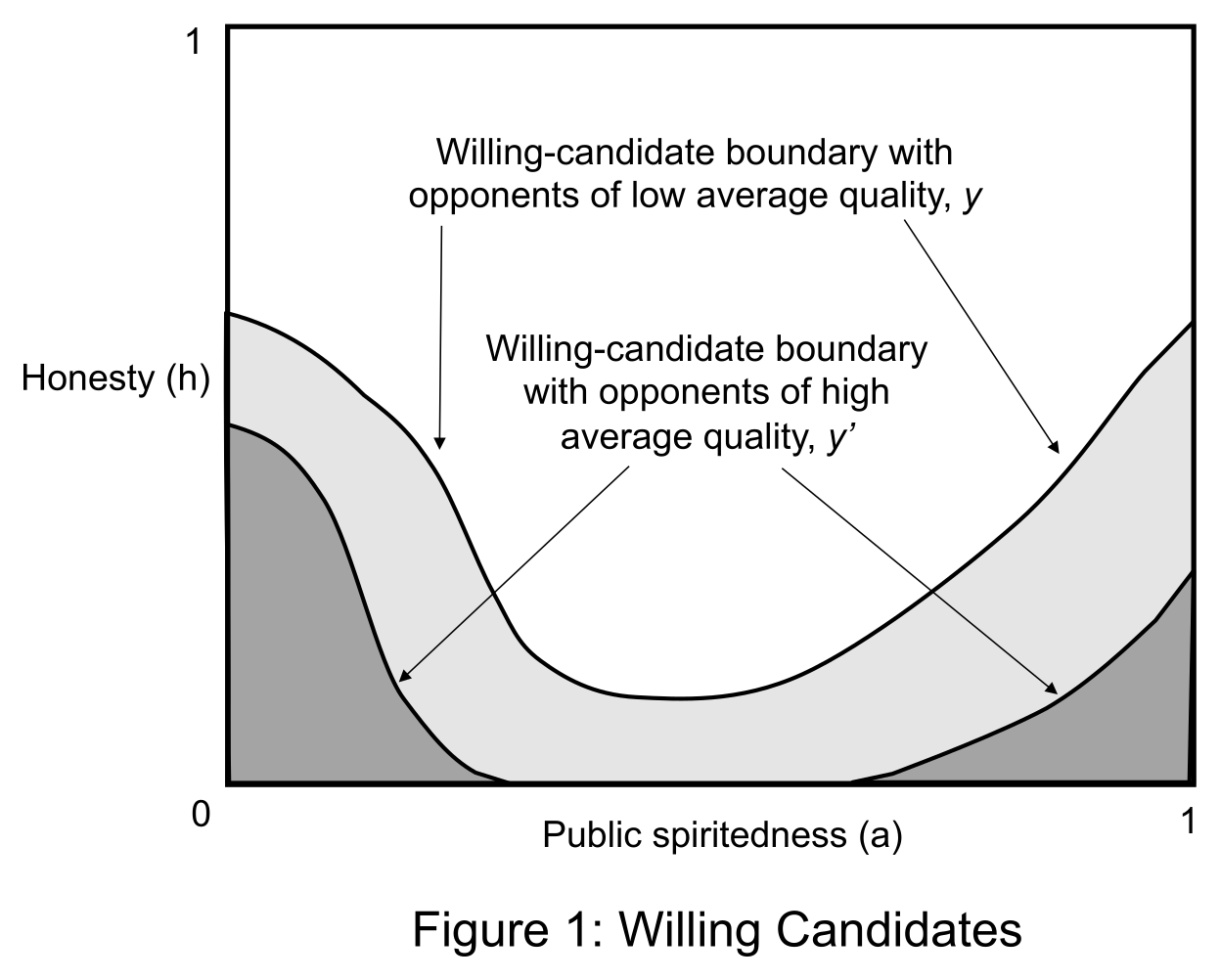
where is the average quality of the other () candidates. Since utility as governor, , decreases with the level of the governor’s honesty, , it follows that if the willing-candidate constraint is satisfied for some individual, it is also satisfied for less honest individuals with the same level of public spirit. Thus, the equation defines the boundary between candidates who are willing and not willing to run for office, given opponents of average quality . Figure 1 depicts this willing-candidate boundary for two different levels of average opponent quality, , and the associated set of willing candidates (shaded). Lemma 1 in the Appendix verifies that the boundary is single-troughed, as in the figure.
We next define a willing-candidate-quality correspondence, , that maps the average quality of opponents into the quality levels of all candidates who are willing to run:
It is routine to verify that an increase in the opponents’ average quality, , shrinks (weakly) the set of willing candidates (and hence ), and therefore reduces the quality of the best willing candidate (i.e., ).
If the set of willing candidates given the average quality of the opponents is path-connected (as it is for the value in Figure 1), then the willing-candidate-quality correspondence is convex-valued, because is continuous. However, the set of willing candidates need not be path-connected for all levels of opponents’ average quality. An inspection of (11) reveals that when opponents’ average quality increases, the willing-candidate boundary shifts downward, and more so at higher values of because more public spirited individuals attach greater weight to quality. Consequently, when opponents’ average quality is sufficiently large, the willing-candidate boundary can intersect the -axis twice (as it does for the value in Figure 1), in which case the set of willing candidates (dark shading in Figure 1) is not path-connected, and the willing-candidate correspondence may not be convex-valued.
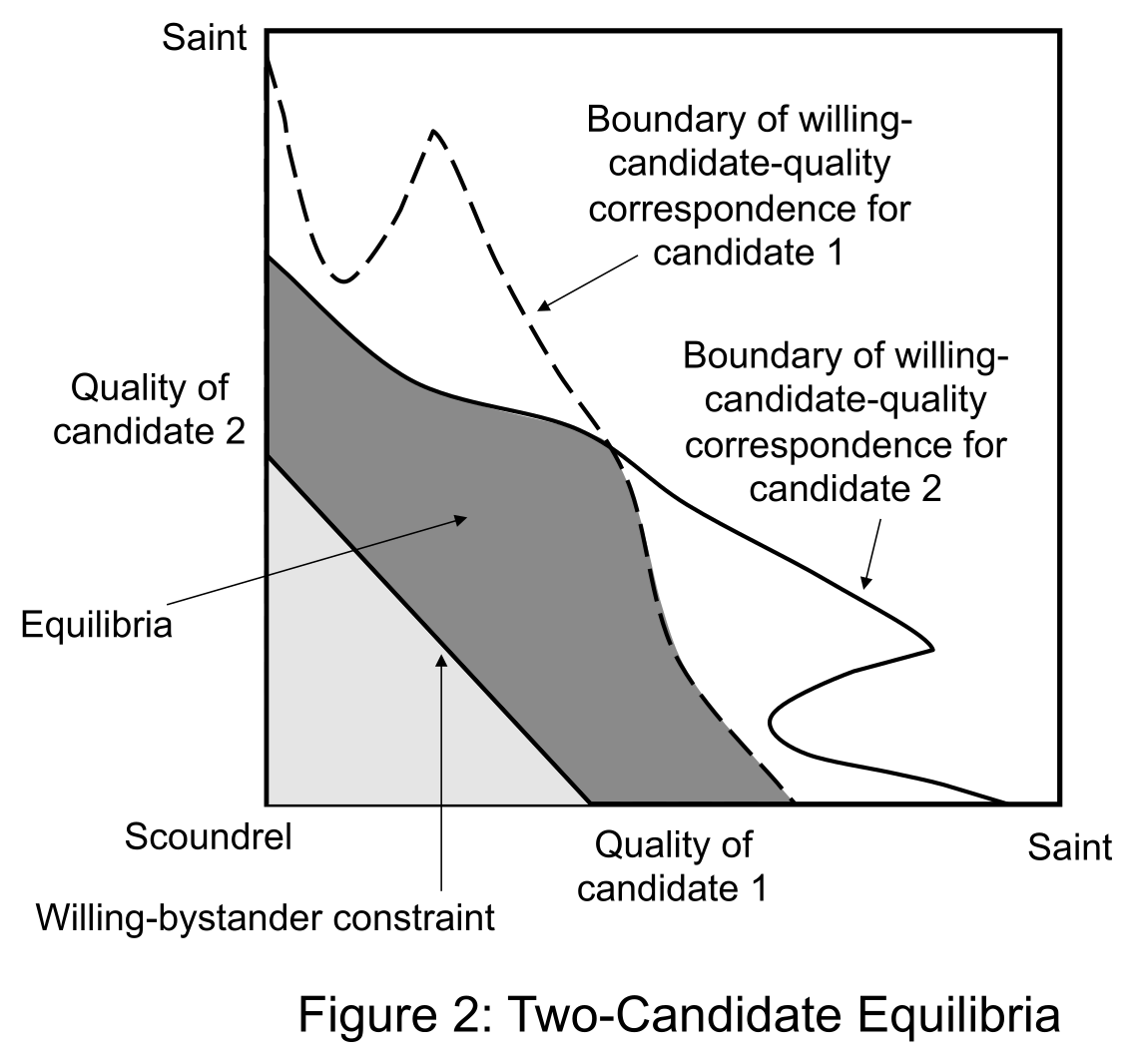
Figure 2 illustrates willing-candidate-quality correspondences with two candidates: for candidate 1, it is bounded by the dashed curve, and for candidate 2, it is bounded by the solid curve. We have drawn each correspondence as convex-valued for low values of but not for moderate values, reflecting the possibilities shown in Figure 1. We have also drawn the correspondences as empty for high values of to illustrate the possibility that there may be no willing candidates when the average of quality of opponents is too high. Together, the two willing-candidate constraints require that the candidates’ qualities correspond to a point in the light- or dark-shaded areas. In this case, these constraints indeed establish only an upper bound on the expected quality of governance.
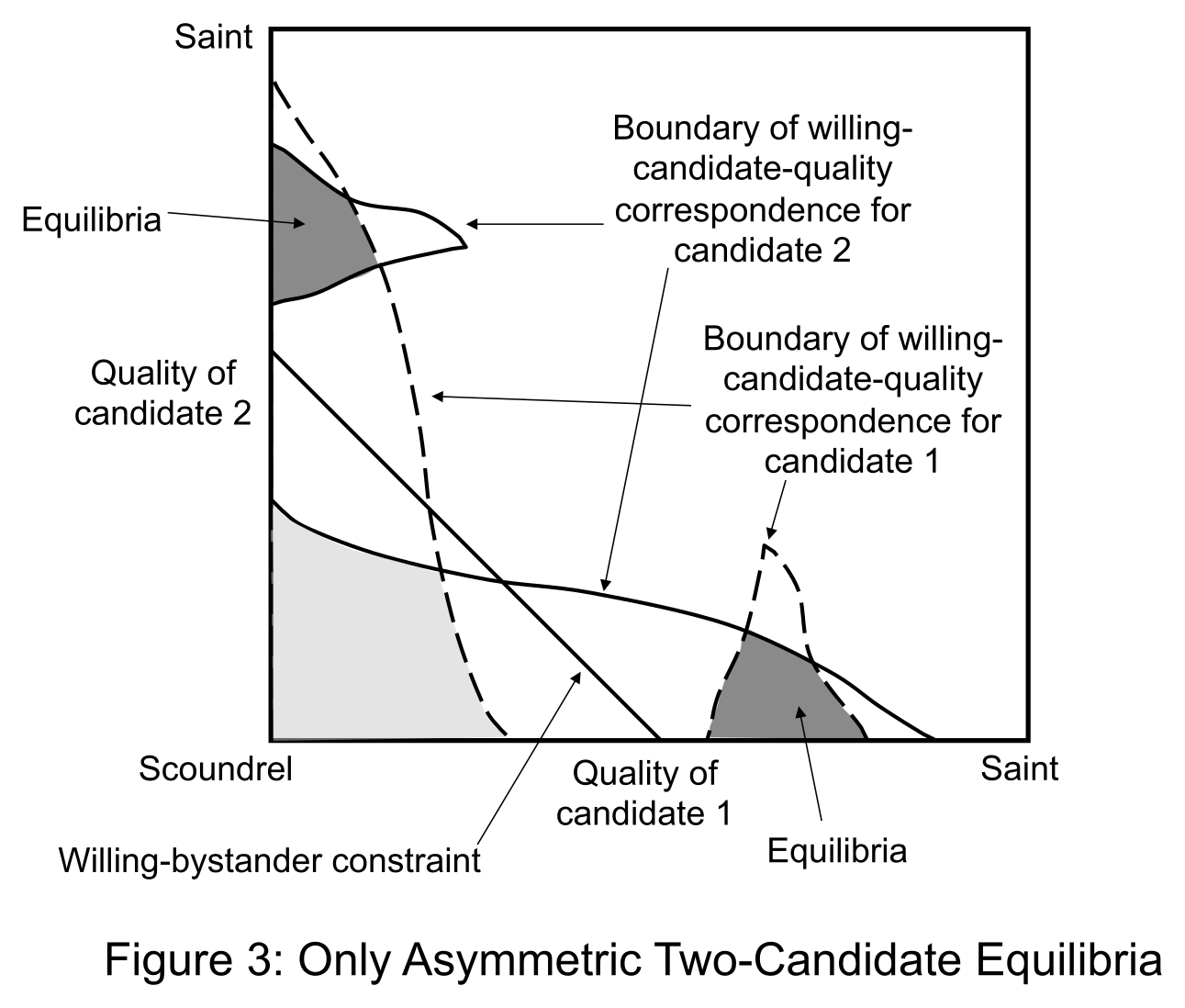
Under less favorable entry conditions, the willing-candidate correspondence for candidate 1 will shift to the left, and the one for candidate 2 will shift downward. It is then possible that neither correspondence will be convex valued even for low values of . We illustrate such a case in Figure 3. Once again, the two willing-candidate constraints are satisfied only for candidate-quality pairs in the light- or dark-shaded regions. In this case, these constraints not only establish an upper bound on the expected quality of governance, but also rule out intermediate values.
4.1.2 The willing-bystander constraints
Intuitively, the willing-bystander constraints collectively provide a lower bound on the expected quality of governance: if expected quality is sufficiently low, new candidates will enter. This subsection derives the lower bound.
Generally, most of the willing-bystander constraints do not bind. The ones that do bind (and hence matter) are associated with the types of non-candidate insiders who have the greatest incentive to run for office. If is the average candidate quality, the magnitude of that incentive is given by .252525For this expression, we can ignore the probability of winning as well as the cost of running because these factors affect all potential candidates equally. An individual of type has a strict incentive to enter if and only if . The governor’s personal benefit from lobbying is weakly decreasing in his honesty, . As was shown in Section 3, the benefits from holding office (both and ) are convex in public spirt, . It follows that either Scoundrels or Sell-Outs (or both) have strictly greater incentives to run than all other insiders.
Between Scoundrels and Sell-Outs, the type with the greater incentive to run depends on and , which differentially affect their gains from holding office. Low (resp. high) provides relatively greater (resp. lesser) incentives for Sell-Outs due to their greater public spirit. Consequently, there is a threshold quality level, , such that the non-candidate insiders with the greatest incentives to run are all Sell-Outs if , all Scoundrels if , and both Sell-Outs and Scoundrels if . Lemma 3 in the Appendix formalizes these points and defines .
It follows that all of the willing-bystander constraints are satisfied if and only if they are satisfied for Scoundrels and Sell-Outs. Accordingly, the set of constraints (10) is equivalent to the following simple lower bound on average candidate quality:
| (12) |
With two candidates, (12) simply requires . Hence, in the -plane, we can represent the constraint as a straight line with a slope of , as shown in Figures 2 and 3; no equilibrium quality pair can lie below this line.
4.1.3 The equilibrium set
Figures 3 and 4 show how to identify two-candidate equilibria. In each figure, the sets of equlibrium quality pairs correspond to the points in the dark-shaded regions, which (by construction) satisfy the willing-candidate constraints and the willing-bystander constraints.
Two features of Figure 3 merit notice. First, the willing-candidate constraints bound average quality from above, while the willing-bystander constraints bound average quality from below. Thus, in a multi-candidate equilibrium, the candidate pool tends to be of intermediate quality: neither too good (or opponents would drop out) nor too bad (or others would enter).262626One might argue that there are more compelling explanations for why the citizens of highest quality do not run for office, e.g., that they have better opportunities in the private sector. It is important to bear in mind, however, that our analysis focuses not on competence or ability, but rather on honesty and public-spiritedness. It is not at all obvious that these dimensions of candidate quality are positively correlated with private sector opportunities. We readily grant that the mediocrity of politicians with respect to competence reflects other considerations; our analysis shows, in addition, why politics does not attract the most public-spirited or honest citizens among those with any given level of competence. In effect, citizens of the highest character have less incentive to enter politics than those who are willing to benefit from corruption. Second, because the upper and lower boundaries on the set of equilibrium quality pairs slope downward, there will tend to be negative correlation between public-spiritedness and honesty among candidates, even if those characteristics are unrelated in the population from which candidates are drawn.
Two features of Figure 4 are also noteworthy. First, the lower bound on the expected quality of governance is determined by the willing-candidate constraint rather than the willing-bystander constraint. Second, in contrast to Figure 3, all equilibria are asymmetric. In such cases, there will necessarily be substantial random variation in the quality of governance from election to election. This is not merely a technical curiosity; we will see subsequently that only analogs of these asymmetric equilibria may survive as the costs of running for office become small.
4.2 Effects of Policy Instruments
We now study the effects of anti-corruption enforcement, , and the governor’s compensation, , on the quality of governance. Since equilibria are not generally locally unique, we focus on the policies’ effects on the highest and lowest expected quality achievable in an equilibrium.
A change in a policy variable ( or ) can affect electoral outcomes either by altering the set of equilibria for a fixed number of candidates (), or by inducing either more or fewer candidates to enter. We begin by studying policy effects for fixed , which are interesting for three separate reasons. First, any directional local comparative static result for the best (or worst) equilibrium with fixed will also generally hold for the overall best (or worst) equilibrium. The exception is when a policy change alters the set of for which equilibria exist in a way that produces a discontinuous jump in the best or worst equilibrium. However, for local policy changes, such exceptions are presumably “rare.”272727To be precise, we conjecture that the policy points at which such exceptions occur are isolated. Second, even when a policy change crosses one of the exceptional points in the parameter space, one still obtains a better understanding of comparative statics by examining the component effects separately. Third, it is possible that social norms, potentially reinforced by slowly changing institutions (such as parties), would create inertia with respect to the number of candidates, so that would remain fixed whenever feasible.
4.2.1 Comparative Statics with a Fixed Number of Candidates
As we will see, with fixed, anti-corruption enforcement has both an incentive effect (an impact on the post-election behavior of the governor) and a selection effect (an impact on the composition of the candidate pool through the willing-candidate and willing-bystander constraints), which work in opposite directions. In contrast, the governor’s compensation only has a selection effect.
Theorem 1.
Assume that for , -candidate equilibria exist for some range of policy parameters. The expected quality of governance in the best such equilibrium weakly decreases with higher anti-corruption enforcement and weakly increases with higher compensation (strictly unless all candidates are Saints).
The intuition for this result is as follows. From Figures 3 and 4, it should be clear that when a policy change expands the set of willing-candidate quality levels regardless of the opponent’s quality, it will improve the best equilibrium. Plainly, higher compensation produces such an expansion. What is perhaps more surprising is that increased anti-corruption enforcement has the opposite effect. To understand why, suppose a given candidate is willing to run against opponents of average quality when the enforcement level is . Then, for some slightly lower enforcement level, , there is a slightly more honest potential candidate who experiences the same disutility from selling out as does the first candidate under policy . Now recall from the end of Subsection 3.3 that both candidate quality and the governor’s utility (and hence the incentive to enter, ) depend on and only through the disutility from selling out. Since the second candidate’s incentive to enter under policy is the same as the first candidate’s under policy , the second candidate is willing to run against opponents of average quality when the enforcement level is . Furthermore, the second candidate’s quality under policy is the same as the first candidate’s under policy . It follows that a reduction in anti-corruption enforcement cannot reduce the set of willing-candidate quality levels.
Analysis of the worst equilibria is more complicated because it could be determined by (i) the willing-bystander constraint, as in Figure 3, (ii) the willing-candidate constraint, as in Figure 4, or (iii) neither, and hence by the quality of Scoundrels. Case (iii) is easiest, because the expected quality of governance in the worst equilibrium is simply , which is increasing in the level of anti-corruption enforcement and unaffected by compensation. For case (ii), the policy effects on the worst equilibrium are precisely opposite those for the best equilibrium: greater anti-corruption enforcement leads to an improvement, and higher compensation makes matters worse. In light of the intuition provided for Theorem 1, the reason is clear: expanding a set has opposite effects on its maximum and its minimum.282828If the set of equilibrium expected quality levels is non-convex, changes in the best and worst equilibria do not completely characterize the effects of policy changes on the range of expected governance quality. Suppose the set in question is a sequence of disjoint intervals. In that case, an increase in (resp. ) increases (resp. decreases) the upper bound of every interval, and decreases (resp. increases) the lower bound (some of those effects being strict and some weak). Additional intervals may also appear. For case (i), we have the following result:
Theorem 2.
Assume that for , -candidate equilibria exist for some range of policy parameters. If, throughout this range, the expected quality of governance in the worst -candidate equilibrium is determined by the willing-bystander constraint, it strictly decreases with higher anti-corruption enforcement and strictly increases with higher compensation.
The intuition for this result is as follows. An increase in compensation improves the worst equilibrium because it increases the lure of running for office, and consequently renders potential candidates less willing to settle for poor governance; thus, the lower bound on the quality of governance must rise. Once again, the surprise is that anti-corruption enforcement has the opposite effect; after all, greater enforcement has a positive incentive effect on the quality of any given candidate, and it is not obvious that selection effects are of the opposite sign and dominate. However, the explanation is straightforward. Recall that the willing-bystander constraint is satisfied when non-candidate Scoundrels and Sell-Outs have no incentive to run for office. It is straightforward to check that these incentives are strictly decreasing in the level of anti-corruption enforcement. Hence, with more aggressive enforcement, a lower average-quality group of candidates can go unchallenged.
Together, Theorems 1 and 2 imply that, in what we view as the most interesting case (where the willing-bystander constraint determines the lower bound on equilibrium quality), both the best and the worst -candidate equilibria improve as the governor’s compensation increases, and as anti-corruption enforcement declines.
4.2.2 Comparative Statics Involving the Number of Candidates
Now we turn our attention to the questions of whether a change in a policy variable can alter the set of for which equilibria exist in a way that produces a discontinuous jump in the best or worst equilibrium, and how such possibilities affect comparative statics of the policy instruments. The discussion in this section is intuitive and informal; the next section will derive formal results when entry costs vanish.
First consider the effect of different values of . The only effect an increase in has on any insider’s entry incentive is to reduce the probability of winning the election. Hence, as is readily verified, the willing-candidate constraints become more restrictive, which reduces expected quality in the best equilibrium, while the willing-bystander constraints become less restrictive, which reduces expected quality in the worst equilibrium (assuming this constraint binds). Two conclusions follow. First, with respect to the expected quality of governance, an increase in the number of candidates tends to generate detrimental selection effects: from the perspective of selection, the fewer candidates the better.292929We say “tends to” because there may be exceptions, depending on which constraints bind and the nature of non-convexities. Second, the best equilibria tend to involve the smallest feasible number of candidates, and the worst equilibria tend to involve the greatest.
Now consider the effects of policy variables on the existence of equilibria with any given number of candidates. Intuitively, higher compensation makes entry more attractive, which can eliminate equilibria with smaller numbers of candidates and introduce equilibria with larger numbers of candidates. More aggressive anti-corruption enforcement would have the opposite effect. It follows from this observation and the arguments in the previous paragraph that when a change in a policy variable creates a discontinuous jump in the best or worst equilibrium by suitably changing the set of for which equilibria exist, the effects tend to work in the opposite direction from those examined in the previous sub-section for fixed .
For small policy changes that cross one of these exceptional points in the parameter space, the effects discussed in this section will dominate (because the effect for given will also typically be small), reversing the conclusions of the preceding sub-section. In contrast, for large policy changes, one cannot generally say which effect will dominate. However, as we show in the next subsection, it is possible to evaluate all the pertinent effects in combination when the costs of running for office are treated as vanishingly small, a common assumption in the citizen-candidate literature.
4.3 Equilibria with Small Entry Costs
We now examine the behavior of the model as becomes vanishingly small. As before, we focus on multiple-candidate equilibria and their comparative statics, accounting simultaneously for all of the effects discussed in Subsection 4.2. More specifically, we assume that parameters are such that single-candidate equilibria do not exist when running costs are sufficiently small.303030Lemma 5 in the Appendix establishes that as running costs vanish, all equilibria are multiple-candidate equilibria if and only if the quality of a Saint is lower than some threshold that is determined by the willingness of Sell-Outs and Scoundrels to enter costlessly against a Saint. We assume throughout this subsection that this condition is satisfied. For example, it is sufficient (but not necessary) that compensation be large enough.
Due to integer constraints, the existence of pure-strategy equilibria is not generally assured. Consequently, we now broaden the scope of our analysis to include mixed-strategy equilibria. We study mixed-strategy equilibria in which insiders probabilistically run for office if and only if they belong to a finite or countably infinite set of (potential) candidates. Formally, a mixed-strategy equilibrium—or just equilibrium hereafter—consists of a denumerable set of political insiders with cardinality , plus an -dimensional vector , where each is the probability of the respective insider running, such that the natural generalizations of the willing-candidate and willing-bystander constraints, (9) and (10), are satisfied (see the Appendix for specifics). Insiders not in the set run with zero probability. A multiple-candidate equilibrium refers to any such with . Clearly, this formulation subsumes pure-strategy equilibria. Given any , whether an equilibrium or not, we denote the associated expected quality of governance by .
As we are not aware of an equilibrium existence result that applies to the current framework,313131Following Schmeidler (1973), existence results in games with a continuum of players generally assume that choices by a measure zero set of opponents do not affect a player’s payoff. That requirement is obviously not satisfied here: for example, if an insider chooses to run, his (expected) payoff depends on the exact number and identities of opponents. we record the following:
Theorem 3.
For any , a mixed-strategy equilibrium exists.
Assured of existence, we next establish the crucial result that as the cost of running for office approaches zero, the character of every candidate must approach that of either a Scoundrel or a Sell-Out.
Theorem 4.
For any , there exists such that when , any multiple-candidate equilibrium, , satisfies: if , then , where denotes an open ball of radius around the point .
In proving this result, a key step demonstrates that as running costs vanish, so does the probability that any particular candidate will win the election (see Lemma 6 in the Appendix). It follows that, in the limit, the willing-candidate constraints are virtually identical to the willing-bystander constraints, except that the direction of the inequality is reversed. Theorem 4 then follows from the earlier observation that either Scoundrels or Sell-Outs always have the greatest incentive to run for office. For, if a candidate were of any other type, the fact that the willing-candidate constraint is satisfied for that candidate would imply that the willing-bystander constraint is violated for either Scoundrels or Sell-Outs, precluding an equilibrium.
Given this characterization of the support of candidates’ character types, the expected quality of governance can now be pinned down. Recall that we had defined as the expected quality of governance that equalizes the incentives to enter for Sell-Outs and Scoundrels: for , Scoundrels have greater incentive to enter than Sell-Outs, and vice versa for .
Theorem 5.
For any , there exists such that when , any multiple-candidate equilibrium, , satisfies
where denotes an open ball of radius around .
In other words, as entry costs vanish, the equilibrium quality of governance converges to , but is truncated above at the quality of a Sell-Out and below at the quality of a Scoundrel. To build intuition for this result, suppose is strictly between the quality of a Scoundrel and that of a Sell-Out. Theorem 4 says that, as entry costs vanish, Sell-Outs and Scoundrels run for office. Clearly, the equilibrium cannot consist of all Scoundrels, because that would entail , which implies that Sell-Outs would have greater incentive to enter than Scoundrels. Similarly, the equilibrium cannot consist of all Sell-Outs, because then we would have , which implies that Scoundrels would have greater incentive to enter than Sell-Outs. Thus, the equilibrium must involve a non-degenerate mixture of Scoundrels and Sell-Outs. To preserve a mixture in the limit, Scoundrels and Sell-Outs must have the same incentives to enter, which implies that .
Together, Theorems 4 and 5 have a surprising and important implication: with small entry costs, the quality of governance is typically highly variable.323232 “Typically” because this requires , which we view as the interesting case. Though all candidates are maximally dishonest, they vary widely in public spirit. A given election can yield a governor with either extremely high or extremely low public spirit (Sell-Outs or Scoundrels), and hence either the maximum or minimum level of the public good. Thus, analogs of the asymmetric equilibria identified in Subsection 4.2 typically turn out to be the only ones that survive in the limit. It is worth remembering, however, that when entry costs are not small, asymmetric equilibria can also yield substantial variability with respect to the governor’s honesty; it is only as that all candidates necessarily become maximally dishonest.
Theorem 5 also allows us to determine the effects of our two public policy instruments, and , on the expected quality of governance as vanishes. We begin with , the governor’s compensation. Since , , and are all independent of , it follows that, in the limit, changes in compensation have no effect on the expected quality of governance. The reason is clear when the candidates are either all Sell-Outs or all Scoundrels: in such cases there are no candidate selection effects, and selection provides the only possible channel through which compensation can influence the quality of governance. More interestingly, the result tells us that when both Sell-Outs and Scoundrels run for office, the typically detrimental selection effects that an increase in has through stimulating additional entry exactly offset, at the limit, the beneficial selection effects for a fixed number of candidates.
Next we consider the effects of , the level of anti-corruption enforcement. Plainly, both and are strictly increasing in . Furthermore, is also strictly increasing: while increased anti-corruption enforcement makes holding office less attractive to both Scoundrels and Sell-Outs, it has a stronger effect on Scoundrels because they succumb to lobbying more often; hence, a higher expected quality of governance is required to restore equal entry incentives. (See Lemma 3 in the Appendix for a formal proof.) Therefore, Theorem 5 implies that in the limit as , an increase in unambiguously improves the quality of governance. The explanation is again clear when the candidates are either all Sell-Outs or all Scoundrels: with no selection effects, an increase in must be beneficial because it has positive incentive effects on both types. When Sell-Outs and Scoundrels both run for office, selection effects also come into play. If an increase in did not affect the expected quality of governance that equalizes entry incentives for the two types, then the policy change would have no net benefit—the positive incentive effects would be exactly offset by a selection effect shift toward more Scoundrels. However, as already noted, higher expected quality is in fact required to preserve equal incentives for Sell-Outs and Scoundrels to run for office. Thus, in the limit as , the direct incentive effects of anti-corruption enforcement and the typically beneficial selection effects associated with deterring additional entry combine to more than offset the typically detrimental selection effects for a fixed number of candidates.
While the direction of this effect is consistent with simple intuition, the mechanism is rather surprising and worth emphasizing. As entry costs vanish, any effect of anti-corruption enforcement, , on candidate selection operates entirely through public-spiritedness (the mix of Scoundrels and Sell-Outs), rather than through honesty (given that all candidates are maximally dishonest in the limit). Also, recall from Theorems 1 and 2 that if the number of candidates is held fixed, the positive incentive effects of anti-corruption enforcement on a governor’s incentives are typically more than offset by perverse selection effects. Thus, as entry costs vanish, anti-corruption enforcement is on balance beneficial only because it also reduces the number of candidates in equilibrium, thereby indirectly improving selection.
Setting aside the incentive effects of increased anti-corruption enforcement, it is also of interest whether the overall selection effects are beneficial or not as entry costs vanish; i.e. are the typically detrimental effects for a fixed number of candidates dominated by the typically beneficial effects operating through reduced entry? This is equivalent to asking whether the ratio among candidates of Sell-Outs to Scoundrels falls or rises at the limit. It turns out that either may happen.
The following result summarizes our policy conclusions:
Theorem 6.
Consider multiple-candidate equilibria in the limit as the costs of running become vanishingly small. An increase in anti-corruption enforcement () strictly increases the expected quality of governance but may increase or decrease the fraction of Sell-Outs who run for office relative to Scoundrels, while a change in the governor’s compensation () has no impact on the expected quality of governance or the composition of the candidate pool.
4.4 An Extension: Observably Differentiated Candidates
So far we have assumed that the electorate cannot distinguish at all between candidates’ character. In practice, information concerning candidates’ personal backgrounds and track records in other positions may be available, and this has been found to influence voters’ choices (e.g. Banerjee et al., 2010, 2011). Indeed, some scholars argue that elections for lower office may improve electoral outcomes for higher office by providing opportunities for candidates to establish reputations, thereby beneficially filtering the set of candidates (e.g. Cooter, 2003; Myerson, 2006). We examine these possibilities here by extending our model to allow for observable differences among candidates. Our main conclusion is that a change in the information structure (such as the provision of more extensive background information) has no effect on the set of equilibrium candidate-character profiles, provided the information remains inconclusive in a sense made precise below.
Let be an observable parameter that encapsulates the past track record of any particular insider. To keep matters simple, we will assume that is a scalar that lies in the normalized interval , but one could just as easily take it to be a vector. We will also make the following weak but critical assumption: the distribution of has full support on for all .333333Note that this assumption rules out the case where is perfectly observable. Moreover, we implicitly assume that there is a continuum of insiders with each possible . In other words, no track record allows a voter to rule out with certainty the possibility that an insider is of any given type; it is in this sense that observable information is inconclusive.
The introduction of observable differences among candidates potentially complicates the analysis of equilibria. Without such differences, all candidates are indistinguishable, and hence must have the same probability of winning on and off the equilibrium path. With observable differences, the probability with which a candidate wins can depend upon his observable , and the manner in which the probabilities vary with both on and off the equilibrium path will depend on the electorate’s beliefs.
Depending on whether and how one refines the set of equilibria, introducing observable differences among candidates may or may not change the set of equilibrium candidate-quality profiles, compared to the baseline model without observable differentiation.343434To illustrate, suppose we restrict attention to equilibria in which all candidates have the same track record (e.g. the best record, ), and impose no restriction on off-path beliefs. Then it is easy to show that the set of candidate-quality profiles are the same regardless of whether or not the candidates are observably differentiated. The same conclusion follows if one refines beliefs by insisting that perceived candidate quality is increasing in . If one instead imposes a restriction on beliefs in the spirit of the D1 criterion (Cho and Kreps, 1987), attributing unexpected entry to a candidate whose character provides the “greatest” or “most robust” incentive to enter (i.e., the type that would enter for the lowest probability of electoral success), then one can show that equilibrium candidate-quality profiles must satisfy an additional constraint that bounds from below the expected quality of governance. Consideration of equilibria involving candidates with different track records generally opens up additional possibilities. However, if there is a change, it generally reflects the introduction of observable labels (here, ), rather than correlations between those labels and aspects of character ( and ).
To see why, first consider the set of unrefined equilibria (i.e., absent any restriction on off-path beliefs). An equilibrium consists of a candidate set (where each candidate is identified by a triplet ) and a system of beliefs (concerning candidate qualities both on and off the equilibrium path), such that the beliefs are consistent with the true candidate set on the equilibrium path, and such that all willing-candidate and willing-bystander constraints are satisfied, given the beliefs. Now suppose the underlying correlations between , , and change. Since information is inconclusive (in the sense defined above), the set of population types compatible with any observed is unchanged. Therefore, one can assign the same candidate pool and the same system of beliefs, in which case the willing-candidate and willing-bystander constraints continue to hold, because these constraints do not depend directly either on or on the correlations between , , and . It follows that the configuration remains an equilibrium.
In principle, one could impose a belief restriction that depends in some fashion on the correlations between , , and , in which case a change in those correlations could alter the (refined) equilibrium constraints. However, familiar equilibrium refinements do not have that property. To the contrary, typical criteria for restricting off-path beliefs (e.g. Cho and Kreps, 1987) are based on the incentives of each type to make a deviation rather than the underlying frequencies of those types within the population. Thus, the irrelevance of background information is robust to a wide range of equilibrium refinements.
These findings have surprising implications for public policy. First, policies requiring the disclosure of background information concerning political candidates may have little or no effect on the character of elected officials or the quality of governance. To put the matter starkly, the set of equilibria is identical regardless of whether represents zip codes for primary residences, or zip codes supplemented with criminal records (provided the full-support condition is satisfied). Positive effects of information disclosures on voters’ choices, as documented for example by Ferraz and Finan (2008) and Banerjee et al. (2010, 2011), may be rendered ineffective by selection effects once such disclosures are institutionalized. Thus, our analysis may help explain why Chemin (2008) finds no evidence that the election of criminal politicians increases bribe-taking in India following a 2003 Supreme Court ruling mandating that all political candidates reveal criminal records.353535In fact, Chemin finds that bribe-taking is lower when the victorious candidate has a criminal record, which he interprets as indicating that criminal officeholders reduce the prosecution of corruption. Second, our neutrality result provides a cautionary note to the notion that elections for lower office in decentralized democracies beneficially filter the set of candidates for higher office according to their track records, as suggested for example by Cooter (2003) and Myerson (2006).
5 Concluding Remarks
We have examined the impact of special interest politics on the character of self-selected politicians. Our focus has been on two dimensions of character: honesty and public spirit. Our analysis emphasizes the role of selection effects in determining the quality of governance. The effects of public policy instruments, such as the level of the governor’s compensation, the intensity of anti-corruption enforcement, and the disclosure of background information, turn out to be surprisingly subtle. Nevertheless, a number of robust—and in some cases unexpected—findings emerge, which we have summarized in the Introduction and hence will not repeat here. We conclude instead by discussing some additional issues.
We have focussed on a one-time election with no incumbent. Assuming character is at least partially revealed during a governor’s first term, re-election opportunities can promote better governance through three channels. The first is purely mechanical: the electorate gains opportunities to re-elect desirable incumbents. This generates a second channel, which is the standard account of electoral accountability: a desire to be re-elected can have positive incentive effects on the governor. Consequently, even policies such as the governor’s compensation level can have incentive effects (by altering the value of re-election), unlike in the one-period model. The third, and most novel, channel operates through self-selection effects: the benefits of running for office in the first place, as a non-incumbent, rise for high-quality candidates (for whom the odds of re-election are high) relative to low-quality candidates (for whom the odds are low). In a Supplementary Appendix, we formally develop this point in both a two-period model and an infinite-horizon model with a two-term limit.
The Supplementary Appendix also raises a counterpoint: if lower-quality candidates benefit more from re-election than higher-quality candidates, then the possibility of re-election can have pernicious selection effects. Such effects can emerge if, as many have suggested, more senior politicians are able to extract greater pork and/or rents from holding office, e.g. by cultivating relationships with large contributors or obtaining appointments to powerful committees. These possibilities generate adverse self-selection among non-incumbents unless the electorate can differentiate sufficiently well between incumbents of good and bad character. Future research may fruitfully examine the optimal choice of term limits in light of these potentially opposing effects of longer terms on self-selection.
We have assumed throughout that insiders differ only with respect to honesty and public-spiritedness. Another potentially interesting dimension along which candidates may differ is the relative weight they attach to monetary payments, public goods, effort, and honesty. To take a simple case, suppose insiders are differentiated by a third characteristic, , that acts as a multiplier for all monetary payoffs (larger indicating greater weight on money relative to other considerations). In multiple-candidate equilibria, elections will tend to attract those with higher values of . The potential implications for the effects of compensation and anti-corruption enforcement are intriguing. An increase in compensation, , will tend to attract candidates with higher values of , which is deleterious insofar as such individuals will more easily succumb to the influence of special interests. Thus, increasing compensation may reduce the quality of governance. On the other hand, increasing anti-corruption enforcement, , will not have that effect.
We have also assumed throughout that the special interest group interacts with politicians only after they gain office. In practice, such groups also encourage particular candidates to run for office by supporting their campaigns. In our model, lobbies plainly have incentives to reduce entry barriers for citizens of low character such as Scoundrels. The implications of allowing campaign contributions will depend on (i) the amount of information the lobby has about the candidate before he takes office, (ii) the likelihood that voters will observe the contributions, (iii) the extent to which the incentives to support a Scoundrel are diluted by the public goods problem among lobbies (all of which will prefer Scoundrels), and (iv) the extent to which public interest groups provide offsetting incentives.
Appendix
Lemma 1.
The willing-candidate boundary is single-troughed.
Proof.
Applying the implicit function theorem to calculate along the willing-candidate boundary for a point on its interior yields
| (13) |
Since , the sign of (13) is the same as that of the numerator. As the numerator is increasing in both and , it follows that if the boundary is upward sloping in at , it is upward sloping at all points .363636Here, is in the usual component-wise vector order. Thus, for any given , the willing-candidate boundary in -space is single-troughed.
Lemma 2.
A governor’s expected rents from special interest politics, evaluated prior to the realization of , is . The associated impact on the expected payoff of any other citizen with public spiritedness is .
Proof.
The first statement follows from the discussion in the text about the outcome of Nash-bargaining: if , the governor does not implement the project; if , he does and receives a transfer such that . For the second statement, note that is the probability of project implementation. Whenever the project is implemented, non-governor citizens with public spirit suffer a disutility of ; thus, the citizen’s expected cost is .
Lemma 3.
Define
| (14) | |||||
Given any set of candidates, the set of non-candidate insider types with the greatest incentive to enter (i.e. that maximize ) consists of Sell-Outs alone if and only if , Scoundrels alone if and only if , and both Sell-Outs and Scoundrels if and only if . Moreover, is a strictly increasing function.
Proof.
We prove the second statement first. Differentiating (14) and using the definition of from (5) yields
| (15) |
where the inequality is because , and the term in square brackets is strictly positive by Assumption 3.
To prove the first statement, fix policies and define
| (16) |
Fix any . The goal is to determine which pairs of maximize . Since is strictly increasing in , is weakly decreasing in ; moreover, by Assumption 3, is strictly decreasing for sufficiently small. Thus, for each , is maximized uniquely at , so we can restrict attention to candidates with minimal honesty.
Note next that and
Thus, the function is convex in , hence is maximized only by . The proof is completed by observing that
where the second equality is by the definition of .
Lemma 4.
Let be an -candidate slate that satisfies the willing-candidate constraints (9) given anti-corruption enforcement . Then, for , there exists an -candidate slate, , that satisfies the willing-candidate constraints under anti-corruption enforcement , such that .
Proof.
For each , we claim that there exists some with such that
| (17) |
To see this, note first that if , agent would never implement the special-interest project, hence . We can then take such that , since a maximally honest agent never implements special interest projects, no matter the level of anti-corruption enforcement (Assumption 3). So suppose that . Then, because while (by Assumption 3), the continuity of implies that there is some such that . Choose such that .
Now we claim that under anti-corruption enforcement , the slate satisfies the willing-candidate constraints (9). This is trivially true if , so consider . Observe that since (17) holds for all , we have that for any ,
In other words, the expected candidate quality is the same if withdraws from slate under , and if withdraws from slate under . Next note that for any , the payoff to holding office, because, by construction, either (i) both and never accept lobby payments (under and respectively), or (ii) . It follows that (9) holds for under .
Proof of Theorem 1.
First fix some and consider an increase in anti-corruption enforcement from to . Let be the best equilibrium with candidates under . By Lemma 4, there exists a slate of candidates, , such that and satisfies the willing-candidate constraints (9) under . Since the willing-bystander constraints (10) amount to a lower bound on equilibrium expected candidate quality under , and because -candidate equilibria are assumed to exist under , either is an equilibrium under or there is some -candidate equilibrium under with strictly higher expected candidate quality.
Next fix some and consider an increase in compensation from to . Note that this change does not affect any citizen’s quality. Let be best equilibrium with candidates under . Inspection of (9) reveals that satisfies the willing-candidate constraints with strict inequality under because salary does not affect any citizen’s quality but strictly increases the governor’s utility. There are two cases now: either (i) satisfies the willing-bystander constraints (10) under , or (ii) it does not. In the latter case, since (10) amounts to a lower bound on equilibrium expected quality and an -candidate equilibrium is assumed to exist under , some -candidate equilibrium under must have strictly higher expected quality than , so we are done. In case (i), is an equilibrium under . Furthermore, if , then since the willing-candidate constraints (9) hold with strict inequality for under and and are continuous, there exists another slate that satisfies (9) under with . Plainly, also satisfies the willing-bystander constraints (10), and hence is an equilibrium under .
Proof of Theorem 2.
First fix some and consider an increase in anti-corruption enforcement from to . Let be the worst equilibrium with candidates under and similarly under . Given the assumption that the willing-bystander constraints bind in both cases, (12) must hold with equality in both cases, which implies and . The desired conclusion follows from using the formula in (12) to observe that , because both Scoundrels’ and Sell-Outs’ utility as governor is strictly decreasing in the level of anti-corruption enforcement (by Assumption 3).
The proof is analogous for an increase in compensation, because is strictly increasing in .
Lemma 5.
A single-candidate equilibrium exists for arbitrarily small if and only if
| (18) |
Proof.
Recall from fn. 24 that the willing-candidate constraint for a single candidate is always satisfied because the consequences of having no governor are sufficiently dire. Moreover, using (10) and Lemma 3, the willing-bystander constraints in a single-candidate equilibrium are satisfied for arbitrarily small if and only the quality of the single candidate, , is such that and . Since a citizen’s quality is monotonic in each component of his character , the result follows.
Equilibrium conditions for mixed-strategy equilibria. For any given , the probabilities of running translate into probabilities of winning conditional on running for each , denoted .373737The probability of winning for any set of realized candidates remains uniform, but the realized number of candidates is now stochastic; encompasses both sources of randomness. Note that depends on but not on . The unconditional probability of winning in equilibrium is . Consequently, the formula for , the expected quality of governance when the set runs with probabilities , is
where denotes the quality of governance when there is no governor (which, recall, is assumed to be extremely dire).
Henceforth will denote the probability vector obtained from by deleting the element containing the probability of entry for . Thus, if changes his probability of entry from to zero, the conditional probability of winning for any changes to . Likewise, will denote the probability vector obtained from by adding an element indicating that enters with probability one. Thus, if changes his probability of entering from zero to one, the conditional probabilities of winning for any is .
Note that, because all choices and electoral events are independent, the probability of winning conditional on the event that does not win is equal to the probability of winning when does not run, which is . This implies in particular that . As a result, for , we have
| (19) |
The equilibrium conditions for mixed strategies generalize those for pure strategies. Since the expected quality of governance is the same regardless of whether runs and loses or refrains from running, ’s decision is determined by a comparison between (the cost of running), and the probability of winning multiplied by ’s gains conditional on winning. Analogous to (9), the willing-candidate constraints are thus:
| (20) |
with equality when . Analogous to (10), the willing-bystander constraints are:
| (21) |
Since does not depend on a candidate’s character, Lemma 3 continues to apply with the obvious notational changes, so (21) holds if and only if it holds for Sell-Outs and Scoundrels.
Proof of Theorem 3.
Fix any and consider a sequence of restricted models, indexed by , such that in model there are insiders, consisting of Sell-Outs and Scoundrels. For each restricted model in this sequence, the entry game is finite and hence a mixed-strategy equilibrium exists. Fix any selection of equilibria in the sequence of restricted models.
Case 1: Suppose first that, for some , the equilibrium has at least one Sell-Out and at least one Scoundrel entering with zero probability. Then (20) is satisfied for all insiders who enter with strictly positive probability, and (21) is satisfied for all insiders who enter with zero probability. This equilibrium remains an equilibrium when any number of Sell-Outs and Scoundrels are added so long as they enter with zero probability: (20) is unaffected and therefore still satisfied for those who enter with positive probability; while (21) is unaffected and therefore still satisfied by the original insiders who enter with zero probability as well as the new insiders. By Lemma 3, it follows that (21) is also satisfied for any new insiders of other character types. Therefore, the equilibrium of model is also an equilibrium of the unrestricted model, featuring a finite number of candidates.
Case 2: Now suppose that, for all restricted models, either all Sell-Outs or all Scoundrels (or both) enter with non-zero probability. Let be the equilibrium in the -th restricted model; let be the associated vector of entry probabilities for Sell-Outs, listed in non-increasing order; and let denote the associated vector of entry probabilities for Scoundrels, again listed in non-increasing order. Note that (20) implies that there must be strictly positive lower bound on the probability of winning conditional on running, and hence an upper bound, call it , on the expected number of candidates. Consequently, .
For each , define countably-infinite-dimensional vectors and such that and for , and for . For any , and belong to
A key property is that
| (22) |
because the elements are in non-increasing order and . Endow with the Chebyshev norm, , i.e for any , .383838Because of (22), the is well defined even though is infinite-dimensional. One can verify that endowed with is compact.393939To prove compactness, note that (22) implies that for any , there is a some such that for all , any has , and hence for any , implies . It follows that is totally bounded. It is routine to verify that is complete. Thus, there is a subsequence for which and converge respectively to limits . A fortiori, in this subsequence, for any , and . Also, and are each non-increasing in . For the remainder of the proof, restrict attention to the subsequence.
Now consider the unrestricted model, with the continuum of insiders. Let be the countable set consisting of Sell-Outs and Scoundrels, where and (either could be infinite). Let assign the entry probability to the -th Sell-Out in , and the probability to the -th Scoundrel in . We will show that is a mixed-strategy equilibrium.
We first verify the willing-candidate constraint (20). We provide the argument for any Sell-Outs in ; it is virtually identical for any Scoundrels. Pick any Sell-Out . Since , we can focus without loss on only those large enough such that . The willing-candidate constraint for implies that
| (23) |
with equality when . One can show that as , and ,404040A proof for the convergence of goes as follows (the argument for convergence of is along the same lines): Let be ’s probability of winning conditional on running when the first Sell-Outs and Scoundrels running according to the probabilities given in , while all others run with probability zero. Let be some strict upper bound on the probability that one or more members of other than the first Sell-Outs and Scoundrels runs, given . Note that (22) implies that by taking sufficiently large we can make arbitrarily small. Also note that bounds the same probability for when is sufficiently large. It follows that and for large . Moreover, because the probability of winning conditional on running is continuous in the entry probabilities for any finite set of agents, as . Therefore, for any , there exists such that for . from which it also follows that .414141Note that . Given the immediately preceding convergence statements, taking limits delivers the desired conclusion. Thus, passing to limits in (23), we have with equality whenever (because then we must have for all large enough ). We have thus verified that (20) holds any Sell-Out in .
The proof is completed by showing that the willing-bystander constraints (21) hold. By Lemma 3, it suffices to check incentives for Sell-Outs and Scoundrels. We will provide the argument for Sell-Outs; Scoundrels can be treated mutatis mutandis.
We divide the argument into two cases. First suppose there exists a subsequence of the restricted models such that for all large enough , there is some Sell-Out who does not enter in the equilibrium of the -th model. The willing-bystander constraint for implies that for any Sell-Out who does not run in the equilibrium of model :
| (24) |
One can show that as .424242The argument is analogous to that given in fn. 40. Thus, passing to limits in (24), we have which establishes that (21) holds for any Sell-Out .
Now consider the other possibility: in any subsequence of restricted models, it is infinitely often the case that all Sell-Outs enter with positive probability in the model’s equilbirium. Then it is possible to find a subsequence of and a Sell-Out in each model, say , such that for all large , and (recall (22)). As , the willing-candidate constraint (20) must hold with equality:
| (25) |
Pick any Sell-Out . The difference between and owes only to ; similarly for the difference between and . Since , it follows that and . Thus, passing to limits in (25) yields
which establishes that (21) holds with equality for any Sell-Out .
Lemma 6.
For any , there exists such that for all , every multiple-candidate equilibrium satisfies for all .
Proof.
Suppose the claim is false. Then for some there exists an infinite sequence of positive entry costs , and a sequence of associated equilibria such that each contains some with .
Letting denote the realized set of candidates and denote the realized number of candidates, note that
where
| (26) |
For any , we have
In other words, any non-candidate who enters would win with expected probability at least . For each equilibrium , the willing-bystander constraint must be satisfied for Sell-Outs and Scoundrels who are not members of :
| (27) |
and
| (28) |
Given that and , (27) and (28) imply:
| (29) |
The left-hand side of (29) is independent of , and by the hypothesis that single-candidate don’t exist for sufficiently small —equivalently, by Lemma 5, that inequality (18) is violated—it is also strictly positive. On the other hand, since is a constant and , the right-hand side of (29) converges to zero as . Consequently, for sufficiently large the right-hand side must be less than the left-hand side, a contradiction.
Proof of Theorem 4.
Suppose the theorem does not hold for some . Then it must be possible to select a sequence of entry costs for which there is a corresponding sequence of multi-candidate equilibria, with , such that for each the set includes some with . The willing-candidate constraints (9) for each and the willing-bystander constraints (10) for Sell-Outs and Scoundrels who are not in imply
| (30) |
where was defined in (16) and
| (31) |
Let (if necessary, focus on a subsequence that converges, which is assured by compactness). The proof now proceeds in three steps.
Step 1: We claim . To prove this, note that (19) implies
The desired conclusion then follows from the facts that (Lemma 6) whereas the quality of governance is bounded.
Step 2: We claim that . We will prove this by showing . Since , it suffices to show that the limit of is no greater than one. We can express
where is given by (26). Now choose any integer . Since all the terms in the summations above are non-negative and the right-hand side is increasing in , we have
Suppose, as we will prove subsequently, that
| (32) |
Then for any , , which implies that , completing the proof of Step 2. Consequently, all that remains is to prove (32).
Observe that for any convergent sequences and , if and only if . Thus, (32) holds if and only if for all ,
| (33) |
With respect to the denominator in (33): since is convex, Jensen’s inequality yields
| (34) |
where is the expectation using the distribution .
With respect to the numerator in (33), we note that
| (35) |
The right-hand side of (35) represents the probability of having no more than “successes” in independent trials, where each trial has a probability of success . There are now two cases to consider.
Case 1: Suppose first that there is some subsequence of such that for all in the subsequence. Then, Theorem 4 of Hoeffding (1956) implies that the right-hand side of (35) is bounded above by the corresponding probability for a binomial distribution with independent trials and a constant success probability , provided . Thus, for sufficiently large (so that , which Lemma 6 guarantees will occur), we have
| (36) |
Since the binomial distribution corresponding to the right-hand side of (36) is single-peaked and has mode no smaller than , for sufficiently large (so that once again ), the summand on the right-hand side of (36) is maximized for , implying
| (37) | |||||
Combining (34), (35), and (37), we have
There are now two possibilities to consider. The first is that there is some such that for sufficiently large. In that case, for large enough ,
| (38) |
As , and dominates , so the expression on right-hand side of (38) converges to zero. Thus, (33) follows immediately for this case.
The second possibility is that there is no such . In that case, we can assume without loss of generality that as (if necessary by restricting attention to a convergent subsequence). We then have . So fixing some , for sufficiently large we have
| (39) |
As , and dominates , while , so the expression on the right-hand side of (39) converges to zero. Thus, (33) again follows.
Case 2: Now suppose eventually. Without loss, we can assume for all . We will use a subscript of on and to denote the respective objects when is restricted to a finite subset of the first candidates, and let . Then, because for any (adding individuals can only increase the number of realized candidates), the same argument as in Case 1 can be applied to a large enough subset of , allowing us to conclude that for large enough and large enough ,
| (40) | |||||
For any fixed , as , (as was discussed in the proof of Theorem 3), hence , which in turn implies that while . Therefore, taking the limit as in (40) yields
| (41) |
As , and dominates , hence the expression on the right-hand side above converges to zero. Thus, (33) follows.
Step 3: Suppose without loss of generality that the sequence hypothesized at the start of the proof, , converges to some limit , if necessary choosing a subsequence of the original sequence. Since for any , it must also be that . Since (30) holds for all , it follows that
where the equality uses the claims established in Steps 1 and 2 and the continuity of . However, Lemma 3 implies that for , a contradiction.
Proof of Theorem 5.
It is convenient to define
| (42) |
In words, truncates below at the quality of a Scoundrel, and above at the quality of a Sell-Out. We must show that for any , there exists such that when , any multiple-candidate equilibrium, , has .
Suppose the result is false for some . Then it is possible to select a sequence of entry costs for which there is a corresponding sequence of multi-candidate equilibria, , such that for each , . Without loss of generality, we can assume that converges to a limit point , with either (i) for some and for all , or (ii) for some and for all . (If necessary, choose an appropriate subsequence of the original sequence.) We will focus on case (i); the argument for case (ii) is symmetric (replacing Sell-Outs with Scoundrels, and vice versa).
Because for all , Theorem 4 implies that there must be for each such that (a Sell-Out) as . Furthermore, by Lemma 3, Scoundrels have the greatest incentive to run for office. According to (30), equilibrium then requires
where is defined by (31). Taking limits as (and invoking the continuity of , the fact that grows without bound, and Step 2 of the proof of Theorem 4), we have . But with , the right-hand side of the preceding inequality is strictly negative by Lemma 3, a contradiction.
Proof of Theorem 6.
The only portion of the result not proven by the discussion preceding the theorem concerns the ambiguous comparative statics of the fraction of Scoundrels relative to Sell-Outs in the limiting candidate pool. To establish that the comparative statics can go either way, we will assume parameters are such that . Let denote the limiting fraction of candidates who are Sell-Outs. Theorem 4 and Theorem 5 together imply that
Solving this equation for and differentiating with respect to (using (15)) yields:
| (43) |
Suppose the density is constant, say equal to , on . Then (43) reduces to , so long as . A fortiori, if the density is non-increasing on , then in the limit as , raising generates an unfavorable overall selection effect with respect to public-spiritedness.434343More generally, (43) implies that for any distribution , there will be an unfavorable overall selection effect if , the governor’s bargaining power, is sufficiently small.
On the other hand, it is evident from (43) that reasonable parameters can also yield , for example if the density is sufficiently increasing on the relevant interval. In these cases, as becomes vanishingly small, a stronger anti-corruption policy generates a beneficial overall selection effect, because the indirect selection effect through changes in the number of candidates dominates the direct selection effect for a given number of candidates.
References
- Can voters be primed to choose better legislators? experimental evidence from rural india. Note: mimeo, Harvard Universiy Cited by: §1, §4.4, §4.4.
- Do informed voters make better choices? experimental evidence from urban india. Note: mimeo, Harvard University Cited by: §1, §4.4, §4.4.
- Fertility choice in a model of economic growth. Econometrica 57 (2), pp. 481–501. Cited by: footnote 11.
- An economic model of representative democracy. Quarterly Journal of Economics 112 (1), pp. 85–114. Cited by: §1.
- Lobbying and welfare in a representative democracy. Review of Economic Studies 68 (1), pp. 67–82. Cited by: §1.
- Joseph schumpeter lecture: paying politicians: theory and evidence. Journal of the European Economic Association 2 (2–3), pp. 193–215. Cited by: §1, footnote 3.
- Bad politicians. Note: NBER Working Paper No. 8532 External Links: Link Cited by: §1, footnote 3.
- Bad politicians. Journal of Public Economics 88, pp. 759–782. Cited by: §1, footnote 1.
- Do criminal politicians reduce corruption? evidence from india. Note: mimeo, UQAM External Links: Link Cited by: §4.4.
- Signaling games and stable equilibria. Quarterly Journal of Economics 102 (2), pp. 179–221. Cited by: §4.4, footnote 34.
- Who gets on top in democracy? elections as filters. Supreme Court Economic Review 10, pp. 127–141. Cited by: §1, §4.4, §4.4.
- “Plata o plomo?”: bribe and punishment in a theory of political influence. American Politican Science Review 100 (1), pp. 41–53. Cited by: §1, footnote 1.
- Capture by threat. Journal of Political Economy 111 (5), pp. 1123–1152. Cited by: §1.
- Exposing corrupt politicians: the effects of brazil’s publicly released audits on electoral outcomes. The Quarterly Journal of Economics 123 (2), pp. 703–745. Cited by: §1, §4.4.
- Motivating politicians: the impacts of monetary incentives on quality and performance. Note: working paper Cited by: footnote 4.
- Corruption, norms, and legal enforcement: evidence from diplomatic parking tickets. Journal of Political Economy 115 (6), pp. 1020–1048. Cited by: §1.
- Labor supply of politicians. Note: working paper Cited by: footnote 4.
- On the distribution of the number of successes in independent trials. Annals of Mathematical Statistics 27 (3), pp. 713–721. Cited by: Appendix.
- Signaling character in electoral competition. American Economic Review 97 (3), pp. 852–870. Cited by: footnote 14.
- The responsible electorate: rationality in presidential voting 1936–1960.. Belknap Press, Cambridge, MA. Cited by: §1.
- Modeling altruism and spitefulness in experiments. Review of Economic Dynamics 1 (3), pp. 593–622. External Links: Document Cited by: footnote 11.
- Political careers or career politicians?. Journal of Public Economics 92 (3–4), pp. 597–608. Cited by: footnote 1, footnote 4.
- Mediocracy. Note: mimeo, University of Pennsylvania External Links: Link Cited by: footnote 1.
- Paying politicians. Journal of Public Economics 88 (12), pp. 2423–2445. Cited by: footnote 1, footnote 4.
- Federalism and incentives for success of democracy. Quarterly Journal of Political Science 1 (1), pp. 3–23. Cited by: §1, §4.4, §4.4.
- A model of political competition with citizen-candidates. Quarterly Journal of Economics 111 (1), pp. 65–96. Cited by: §1.
- Candidate quality. International Tax and Public Finance 14 (1), pp. 7–27. Cited by: footnote 1.
- Immunity. Note: working paper Cited by: §1.
- Equilibrium points of nonatomic games. Journal of Statistical Physics 7, pp. 295–300. Cited by: footnote 31.